
 General
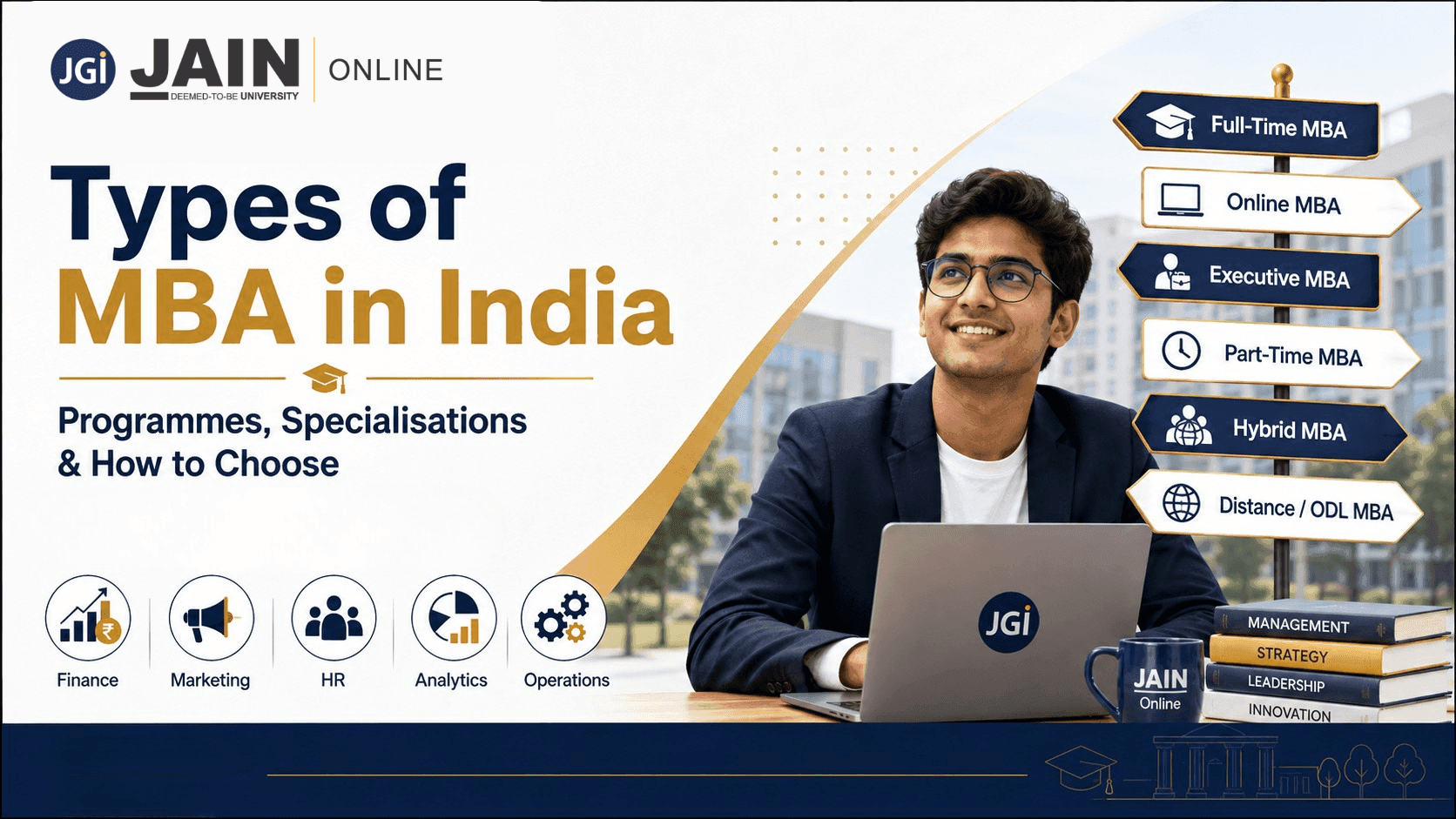
Types of MBA in India: Programmes, Specialisations & How to Choose
The types of MBA in India can be grouped in two ways: by programme format and by specialisation. Common formats include full-time, part-time, executive, online, distance/ODL and hybrid or blended MBAs, while one-year programmes are available at some institutions as well. Separately, learners can choose specialisations such as Finance, Marketing, Human Resource Management, Analytics and Operations depending on their intended career direction.
These different formats help learners with varying career goals and personal commitments find specific programmes that suit them. Many MBA programmes begin with core management subjects before allowing learners to choose electives or specialisations, depending on the institution and programme structure. Some programmes also include internships, live projects, capstone projects or industry interactions to provide practical exposure.
The different types of MBA have different admission requirements that vary by institution and programme type. Universities may consider undergraduate academic performance, entrance examination scores, work experience, interviews and other selection criteria depending on the programme.
This guide explains the different types of MBA programmes available in India, the most popular MBA specialisations, admission requirements, career prospects and practical factors to consider before choosing a programme that fits your long-term goals.
What Are the Popular Types of MBA Programmes in India?
MBA format and MBA specialisation are different. The format describes how the programme is delivered, such as full-time, online, executive or part-time, while the specialisation refers to the management area you study in greater depth, such as Finance, Marketing or Business Analytics.
MBA programmes in India are offered in different formats, each designed to meet the needs of learners at different stages of their careers, making it important to choose a format that aligns with your goals, work experience and availability.
The sections below explain the most common MBA programme types in India, who they are best suited for and the advantages and limitations of each option.
Durations and work-experience requirements are indicative and vary by institution. Applicants should check the current programme structure and eligibility criteria before applying.
Full-Time MBA
A full-time MBA is the traditional management programme where learners attend regular classes on campus and study full-time throughout the duration of the course.It can suit graduates and early-career professionals who want to build management knowledge through an immersive campus-based learning format.
Best suited for
• Fresh graduates
• Professionals with a few years of work experience
• Individuals planning a career change
• Learners looking for campus placements and networking opportunities
Advantages
• Immersive learning environment
• Strong peer and faculty interaction
• Internship opportunities
• Access to campus events, clubs and networking
Things to consider
A full-time MBA generally requires learners to leave their jobs for the duration of the programme. In addition to tuition fees, living expenses and the opportunity cost of taking a career break should also be considered.
One-Year / Accelerated MBA
A one-year or accelerated MBA delivers management education over a shorter, intensive study period. These programmes may be designed for experienced professionals, although eligibility and work-experience requirements vary by institution.
Best suited for
- Experienced professionals
- Learners comfortable with an intensive academic schedule
- Professionals seeking a shorter full-time management programme
Things to consider
Eligibility and work-experience requirements vary considerably across institutions. Because the curriculum is delivered over a compressed period, learners should also consider the programme's workload, internship opportunities and whether the format gives them enough time to pursue their intended career transition.
Executive MBA (EMBA)
An Executive MBA (EMBA) is generally designed for professionals with prior work experience, although eligibility requirements vary by institution. Classes are usually scheduled during weekends, evenings or in short campus residencies, allowing participants to balance their professional responsibilities with higher education.
Best suited for
• Mid-level managers
• Senior professionals
• Business owners and entrepreneurs
• Professionals preparing for leadership roles
Advantages
• Continue working while studying
• Learn alongside experienced professionals
• Immediate application of concepts at work
• Strong executive networking opportunities
Things to consider
Most Executive MBA programmes expect applicants to have relevant work experience. They are generally intended for professionals seeking career progression rather than fresh graduates looking for their first management role.
Online MBA
An online MBA allows learners to complete their management education remotely through digital learning platforms. Lectures, assignments, assessments and discussions are delivered online, making this format suitable for learners who need greater flexibility.
Online MBA programmes can be particularly suitable for working professionals because they allow many learners to continue working while pursuing management education.
For example, JAIN Online's two-year, four-semester Online MBA offers 19 elective pathways, allowing learners to choose from areas such as Finance, Marketing and Human Resource Management, Business Intelligence and Analytics, Data Science & Artificial Intelligence, Digital Marketing & e-Commerce, AI for Finance, AI for Marketing and AI for Human Resources.
Best suited for
• Working professionals
• Entrepreneurs
• Individuals balancing work and family responsibilities
• Learners living away from major education hubs
Advantages
• Flexible study schedule
• Continue working while studying
• Reduced or no relocation and commuting requirements, depending on the learner’s circumstances
• Learn from anywhere with internet access
Things to consider
Success in an online MBA requires consistent time management and self-discipline. Before applying, learners should carefully review the curriculum, faculty, learner support, career services and recognition of the programme.
It is also helpful to evaluate the learning experience offered by the institution. Features such as weekend live classes, structured self-learning resources, discussion forums, virtual labs, personalised academic guidance, dedicated learner support and opportunities to learn from industry professionals can enhance the overall learning journey. For a detailed explanation, read our guide on whether an online MBA is valid in India.
Part-Time MBA
A part-time MBA is designed for professionals who want to improve their management skills without leaving their jobs. Classes are usually conducted during evenings or weekends, allowing learners to balance their education with work commitments.
These programmes often extend over a longer duration than full-time MBAs because of their flexible schedules.
Best suited for
• Working professionals
• Managers seeking career growth
• Professionals unable to take a career break
Advantages
• Continue earning while studying
• Apply classroom learning directly at work
• Better work-study balance
Things to consider
Internship, networking and career-support opportunities vary by institution, so learners planning a career transition should compare these features carefully.
Hybrid MBA
A hybrid MBA combines online learning with periodic on-campus sessions. Learners attend most classes online while participating in workshops, networking events or academic sessions on campus at scheduled intervals.
This format offers flexibility without completely giving up face-to-face interaction.
Best suited for
• Working professionals
• Learners who value both flexibility and classroom interaction
• Individuals who cannot relocate for a full-time programme
Advantages
• Flexible learning
• Interactive classroom sessions alongside digital learning
Things to consider
The frequency of campus visits varies by institution, so applicants should review the programme structure before enrolling. Because “hybrid” or “blended” may describe how learning is delivered rather than the formally recognised mode of the degree, applicants should verify the programme's official mode and any mandatory campus requirements before enrolling.
Integrated MBA
An Integrated MBA combines undergraduate and postgraduate management education within a single programme, typically beginning after Class 12. It is mainly relevant to learners who are already certain that they want to pursue management education early in their academic journey.
Because this article primarily targets graduates and working professionals, readers who already hold a bachelor's degree would normally compare postgraduate MBA formats instead.
Distance/ODL MBA
A Distance or Open and Distance Learning (ODL) MBA allows learners to pursue management education with greater location and schedule flexibility. Compared with fully online programmes, ODL may involve a greater degree of self-directed study, although the precise delivery model varies by institution.
Applicants should verify the institution's entitlement to offer the MBA in ODL mode for the relevant academic session and review the learning resources, assessment structure, learner support and any in-person requirements before enrolling.
What Are the Popular Types of MBA Specialisations?
Choosing the right MBA specialisation is just as important as selecting the right programme format. Your specialisation influences the subjects and skills you develop and can shape the types of roles you may choose to explore.
Many MBA programmes include core management subjects before allowing learners to build deeper expertise through electives or specialisations, depending on the programme structure.
The table below compares some of the most popular MBA specialisations available in India.
For a deeper comparison, explore which MBA specialisation is best for different career goals.
MBA in Finance
An MBA in Finance focuses on managing an organisation's financial resources and making informed business decisions. Learners study topics such as corporate finance, investment management, financial markets, risk analysis and financial planning.
This specialisation is well suited to individuals who enjoy working with numbers, analysing financial data and understanding how businesses create long-term value.
Possible Career Directions include:
• Financial Analyst
• Investment Banker
• Corporate Finance Manager
• Treasury Manager
• Risk Analyst
Before choosing this specialisation, consider whether you enjoy analytical work and quantitative problem-solving, as many finance roles require strong numerical and decision-making skills.
MBA in Marketing
An MBA in Marketing prepares learners to understand consumer behaviour, build brands and develop marketing strategies across traditional and digital channels.
The curriculum often covers brand management, digital marketing, market research, advertising, consumer psychology and marketing analytics.
Possible Career Directions include:
• Marketing Manager
• Brand Manager
• Digital Marketing Manager
• Product Marketing Manager
• Market Research Analyst
This specialisation is suitable for learners who enjoy creativity, communication, customer engagement and analysing market trends.
MBA in Human Resource Management
Human Resource Management focuses on managing an organisation's workforce, improving employee performance and creating effective workplace policies.
Learners typically study recruitment, talent management, compensation and benefits, organisational behaviour, performance management and employment laws.
Possible Career Directions include:
• HR Manager
• Talent Acquisition Specialist
• HR Business Partner
• Learning and Development Manager
• Employee Relations Manager
This specialisation is ideal for individuals who enjoy working with people while balancing organisational and business objectives.
MBA in Business Intelligence and Analytics
Business Intelligence and Analytics combines management principles with data analysis to support better business decisions.
The curriculum generally includes business intelligence, data visualisation, predictive analytics, statistics and analytical tools used across industries.
Possible Career Directions include:
• Business Analyst
• Analytics Consultant
• Product Analyst
• Business Intelligence Analyst
• Data Strategy Consultant
Learners considering this specialisation should be comfortable interpreting data and using analytical tools to solve business problems.
MBA in Information Technology
An MBA in Information Technology bridges technology and business management. It prepares professionals to manage digital transformation, technology projects and IT operations while aligning technology with organisational goals.
Subjects often include IT strategy, project management, cybersecurity, cloud technologies and enterprise systems.
Possible Career Directions include:
• IT Manager
• Technology Consultant
• Product Manager
• Digital Transformation Manager
• Technology Project Manager
This specialisation is particularly suitable for engineering, computer science and IT professionals who want to move into leadership positions.
MBA in Healthcare Management
Healthcare Management combines management education with the operational requirements of hospitals, healthcare providers, pharmaceutical companies and health technology organisations.
Learners study healthcare systems, hospital administration, healthcare operations, quality management and healthcare regulations.
Possible Career Directions include:
• Hospital Administrator
• Healthcare Operations Manager
• Healthcare Consultant
• Health Services Manager
• Pharmaceutical Business Manager
This specialisation is well suited to healthcare professionals and graduates interested in improving healthcare delivery and organisational efficiency.
MBA in Entrepreneurship
An MBA in Entrepreneurship is designed for learners who want to start, manage or expand a business. It focuses on innovation, business planning, venture creation and business growth.
The curriculum often includes entrepreneurial finance, innovation management, startup strategy, business models and fundraising.
Possible Career Directions include:
• Entrepreneur
• Startup Founder
• Business Development Manager
• Innovation Consultant
• Venture Associate
Learners can also benefit from incubators, mentorship programmes and industry projects offered by some institutions.
MBA in International Business
An MBA in International Business prepares learners to work in organisations operating across multiple countries. It covers global trade, international finance, cross-cultural management and international marketing.
Possible Career Directions include:
• International Business Manager
• Export Manager
• Import Manager
• Global Supply Chain Manager
• International Marketing Manager
This specialisation is suitable for learners interested in multinational organisations and businesses with international operations.
MBA in Supply Chain, Production and Operations Management
Supply Chain, Production and Operations Management focuses on improving efficiency across manufacturing, logistics, procurement and business operations.
Learners study operations planning, inventory management, logistics, procurement, quality management and supply chain optimisation.
Possible Career Directions include:
• Operations Manager
• Supply Chain Manager
• Procurement Manager
• Logistics Manager
• Operations Consultant
This specialisation is suitable for learners who enjoy solving operational challenges and improving business processes.
How Do You Choose the Right MBA Specialisation?
No single MBA specialisation is the best for everyone. The right choice depends on your educational background, professional experience, career aspirations and personal interests.
Before selecting a specialisation, ask yourself:
• Which industries would I like to work in?
• What kind of work do I enjoy most?
• Do I prefer analytical, technical, creative or people-focused roles?
• What skills do I already have, and which ones do I want to develop?
• Does the curriculum align with my long-term career goals?
Instead of choosing a specialisation solely because it is currently popular, focus on selecting one that matches your strengths and supports your future career plans.
Industry-Specific and Emerging MBA Options
While most MBA programmes develop broad management skills, some are designed specifically for particular industries. These programmes combine core business subjects with specialised knowledge relevant to a particular sector.
An industry-specific MBA may be suitable if you already know the sector you want to work in or have prior experience in that field.
MBA in Hospitality Management
Hospitality Management combines business education with hotel operations, tourism, customer experience and service management.
Learners may study hospitality operations, food and beverage management, tourism marketing, revenue management and customer relationship management.
Career opportunities include Hotel Manager, Resort Manager, Hospitality Consultant and Tourism Operations Manager.
MBA in Retail Management
Retail Management focuses on managing retail businesses across physical stores and digital commerce platforms.
The curriculum often covers merchandising, customer experience, retail operations, category management, supply chain management and retail marketing.
Graduates may pursue careers as Retail Managers, Category Managers, Store Operations Managers and Retail Business Consultants.
Emerging MBA Specialisations
MBA curricula can also incorporate emerging technologies and newer business practices alongside traditional management education. For example, JAIN Online offers Online MBA electives such as Business Intelligence and Analytics, Data Science & Artificial Intelligence, Digital Marketing & e-Commerce, AI for Finance, AI for Marketing and AI for Human Resources.
How to Choose an Emerging Specialisation
Emerging MBA specialisations can open new career opportunities, but popularity alone should not determine your choice.
Before selecting a niche programme, consider:
• Whether the curriculum aligns with your career goals.
• Whether the skills taught are relevant to the roles and industries you are considering.
• Your existing educational background and work experience.
• Industry exposure, projects and practical learning opportunities.
• Whether current job descriptions in your preferred sector ask for related skills, knowledge or experience.
Choosing a programme that matches both your interests and long-term career plans is generally more beneficial than selecting one simply because it is currently trending.
Which Type of MBA Should You Choose?
The right MBA starts with choosing the format that fits your current career stage and learning needs. Your preferred format should depend on your current responsibilities, learning preferences, eligibility and ability to commit to the programme structure. Once the format is clear, compare specialisations based on the curriculum, skills developed and the roles you intend to pursue.
Before applying, take the time to evaluate the curriculum, flexibility, industry relevance and learner support offered by each institution. A careful comparison can help you choose a programme that better aligns with your learning needs and career direction.
Explore a Flexible Online MBA with JAIN Online
If you need an MBA format that can fit alongside work or other commitments, JAIN Online offers a two-year, four-semester Online MBA with 19 elective pathways. Current programme materials highlight weekend live classes, structured self-learning resources, interactive discussion forums, virtual labs, personalised academic guidance, dedicated learner support and opportunities to learn from industry professionals.
The programme also incorporates AI-enabled learning and micro-credentials alongside the MBA curriculum. Explore the JAIN Online MBA curriculum and available electives to compare them with your professional goals.
Frequently Asked Questions (FAQs)
Q1. Is work experience required for all types of MBA?
Work-experience requirements vary by institution and MBA format. Some programmes may accept applicants without prior professional experience, while others may set minimum experience requirements. Check the current eligibility criteria of the specific MBA programme before applying.
Q2. Is an Executive MBA the same as a one-year MBA?
Not necessarily. An Executive MBA is primarily defined by the audience it serves, usually experienced professionals and managers, whereas a one-year MBA is defined by programme duration. Some executive programmes may last around a year, but not every one-year MBA is an Executive MBA. Compare eligibility, delivery format and target learner profile carefully.
Q3. What is the difference between an online MBA and a distance or ODL MBA?
Both provide alternatives to regular campus study, but their delivery structures can differ. Online MBAs generally use digital learning platforms, scheduled or recorded classes and online interaction, whereas ODL programmes may rely more heavily on self-directed learning, depending on the institution. In India, applicants should verify the institution's entitlement for the specific delivery mode through UGC-DEB.
Q4. Can I choose more than one MBA specialisation?
It depends on the institution. Some MBA programmes provide a single specialisation, while others offer dual electives or combinations across areas such as Finance, Marketing, Human Resources and Analytics. Check how the institution structures electives, whether both areas appear in the curriculum or degree documentation, and whether additional requirements apply.
Q5. Can I change my MBA specialisation after admission?
Possibly, but the rules vary by institution and the stage of the programme. Some universities may permit an elective change before specialised coursework begins, while others may restrict changes after registration. Before enrolling, ask when the specialisation must be finalised, whether changes are permitted and whether changing it affects fees or completion requirements.
Q6. Does the MBA format affect whether the degree is recognised?
Recognition depends on the awarding institution and the programme's authorised mode rather than flexibility alone. For Online or ODL programmes in India, check the institution and programme on the UGC-DEB portal for the relevant academic session and delivery mode. Applicants should also verify any additional requirements applicable to their specific institution or programme.
Related Blogs
 General
Can I Do BCA Without Maths in India? Eligibility Guide
BCA without Maths in India eligibility guide by JAIN Online, featuring a student exploring computer applications, coding and higher education opportunities.
Read More → General
Online BBA vs Offline BBA in India: Key Differences
Online BBA vs Offline BBA in India comparison by JAIN Online, showing a student learning on a laptop and another attending classroom sessions, highlighting flexibility, learning experience, cost and career support.
Read More → General
Online MBA Exam Pattern in India: Assessment, Marks and Exam Format
JAIN Online blog banner featuring a woman studying with a laptop and notebook, highlighting Online MBA Exam Pattern in India with assessment, marks and exam format.
Read More →