
 Programs
Is an Online MBA Worth It in 2026?
You can probably picture two versions of your future: one where you pause your career for two years on a campus, and another where you keep your job and study from home. Still aim for a bigger role, better pay, and broader impact. The real question is not just “Is an MBA valuable?” It is more precise: Is an online MBA worth it for you, given your experience, industry, finances, and timeline? In India, where career paths are rapidly evolving and tech‑enabled learning is mainstream, an online MBA can be a smart catalyst if you choose the right programme and use it strategically.
The timing also matters. MBA employability in India has risen sharply, with reports showing growth from 47% in 2021 to 78% in 2025. While this data refers to MBA graduates overall, it shows why practical, skill-led MBA learning matters. This guide compares online and regular MBAs in terms of cost, ROI, employer acceptance, placement support, accreditation, curriculum quality, and long-term career fit.
Is An Online MBA Worth It Compared To A Regular MBA?
An online MBA is worth considering if you want flexibility, lower opportunity cost, and career growth without leaving your job. A regular MBA may be better if you want campus immersion, peer-driven learning, and structured placement drives.
Both online and on-campus MBAs aim to build core business competencies such as strategy, finance, marketing, operations, and leadership while expanding your professional network. Where they diverge is in delivery format, immersion level, cost structures, and the mechanics of placement support. Many Indian professionals weigh trade-offs between the flexibility and often lower opportunity cost of an online MBA and the immersive, cohort-intensive, and typically stronger campus placement ecosystem of a top on-campus programme.
| Factor | Online MBA | Regular MBA |
| Cost | Usually more affordable, with lower relocation, hostel, commuting, and career-break costs. | Usually more expensive because of tuition, campus fees, relocation, hostel, and living costs. |
| Flexibility | High flexibility. Suitable for learners who want to study while working or managing other commitments. | Lower flexibility. Requires full-time campus attendance and a fixed academic schedule. |
| Placements | Usually offers career support such as CV reviews, interview prep, job boards, projects, and alumni access. | Often offers structured campus placement drives, especially in well-known business schools. |
| Networking | Networking happens through virtual cohorts, alumni groups, online events, LinkedIn communities, and occasional meetups. | Networking is more immersive through campus life, peer groups, clubs, events, faculty, and recruiter interactions. |
| Best Fit | Best for working professionals, entrepreneurs, family-business owners, and learners who need flexibility. | Best for freshers, early-career candidates, and students who want campus exposure and structured placements. |
| Drawbacks | Requires self-discipline and active networking. Placement support may not be the same as guaranteed placement. | Requires higher investment, a career break, and less flexibility for working professionals. |
Value is contextual. An online MBA's worth depends on your experience level, career goals, programme quality and accreditation. For mid-career professionals who cannot step away from income, an accredited online MBA programme can provide a valuable boost in skills and credibility without derailing momentum. For freshers aiming for highly structured campus placements at elite Indian B-schools, the on-campus route still tends to offer a clearer pipeline. However, online programmes increasingly supplement with career services, employer outreach, and industry projects.
How Do Career Opportunities Differ?
On-campus MBAs at well-known Indian institutions often feature intensive meetups and placement seasons with multiple recruiters visiting campus. The process can be efficient and brand‑enhancing, especially for candidates with limited experience. Online MBAs, in contrast, typically emphasise career enablement rather than a single, concentrated placement drive. You are likely to find:
- Continuous career support rather than a single placement week, including CV reviews, interview preparation, mock case interviews, and job boards.
- Project-based pathways: live industry projects, capstones, and consulting assignments designed to produce portfolio evidence of your capabilities.
- Decentralised networking: connections through virtual cohorts, alumni groups, LinkedIn communities, and periodic in-person or virtual career fairs.
What this means in practice:
- If you’re early in your career and seeking a blockbuster first jump, especially into highly competitive roles where brand and campus placements carry outsized weight, an on-campus MBA at a top-tier Indian B-school may still hold an edge.
- If you already have 3 to 10 years of experience and your next move is more about lateral growth, leadership scope, or a pivot within your current company or industry, an online MBA can be a strong catalyst, particularly if the curriculum is current (digital, analytics, product). You leverage projects to make your case.
- For entrepreneurs and family-business professionals, online MBAs can be valuable for immediate application of learning and expanding networks beyond your local market.
In most scenarios, employers focus on what you can do now: your skills, your results, and your clarity of impact. The online MBA route can help you prove that through projects, certifications, and practical deliverables while you remain employed.
Can an Online MBA Improve Salary and Career Growth?
Salary growth after an online MBA is rarely automatic. It usually improves when the degree is paired with stronger business judgement, digital fluency, analytical ability and proof of applied work. Employers are increasingly looking for candidates who can connect strategy with execution, use data to make decisions and communicate impact clearly. This is why projects, dashboards, business models, simulations and capstones matter as much as the degree itself.
With online MBAs specifically, two broad patterns show up:
- Incremental uplift for experienced professionals: When you’re already on a career track, an online MBA can serve as a multiplier, helping you step into roles with broader scope (P&L, team leadership, cross-functional responsibility). The salary impact may be staggered across promotions over 12–36 months rather than overnight.
- Skill-driven boosts over brand-driven boosts: Online programmes tend to emphasise practical, demonstrable skills, such as analytics dashboards, A/B test design, product roadmaps, and financial models, that allow you to justify higher pay by pointing to concrete value creation.
To make this work for you, align your coursework with measurable business outcomes. Examples:
- In marketing, build a multi-channel performance plan with CAC/LTV analysis for interviews.
- In operations, design a capacity plan and cost-optimisation model that you can adapt to your current role.
- In finance, model scenarios (working capital, valuation drivers) that demonstrate decision-making rigour.
Tip: Track your own career value quarterly. Maintain a log of new responsibilities, cost savings, revenue contributions, and leadership achievements you can attribute, at least partially, to MBA-driven skills. This documentation strengthens promotion cases and salary negotiations, regardless of format.
Can An Online MBA Help You Switch Careers?
Yes, an online MBA can support a career switch, but the degree alone is rarely enough. However, the switch mechanics differ by function and seniority. In India, major pivots, from, say, operations to product management, or from a non-tech role to analytics, often require more than a degree. You can improve your chances by combining the degree with:
- Evidence of capability: Industry-recognised certifications, relevant side projects, or contributions in your current role that map to your target function.
- Portfolio artefacts: Product PRDs, customer journey maps, data dashboards, financial models, or go-to-market plans that speak the new function’s language.
- Mentor backing: Warm referrals from professionals already in the target role; structured informational interviews; feedback loops on your resume and pitch.
- Internships or apprenticeships: Short-term engagements or consulting gigs, often remote, that reduce perceived risk for employers and build experience.
In most scenarios, online MBAs open the door, and your execution pushes it wide. If you are switching into areas like digital marketing, analytics, product, or project management, the online format’s flexibility (to do live projects while you study) is a substantial advantage.
What Decides Whether An Online MBA Is Effective?
Not all online MBAs are created equal. Their effectiveness depends on accreditation, pedagogy (live vs recorded balance), cohort strength, assessment rigour, integration with industry, and the career services model. Additionally, your outcomes depend on personal execution: time management, networking, portfolio building, and strategic applications for roles.
Below, we unpack key levers: cost, financing, employer outcomes, and accreditation. Handle these well, and you materially improve your outcomes for a strong ROI.
How Much Does an Online MBA Cost and How Should You Evaluate Value?
Online MBA costs vary widely across Indian universities and global providers. The direct fee is just one part of the total cost; you should also factor in opportunity cost (lost income if you would otherwise study full-time), technology needs, exam fees, optional immersions, travel, and financing costs.
Payback period = total programme cost ÷ realistic annual salary uplift.
Common financing options for Indian learners include:
- Education loans: Offered by banks and NBFCs; terms vary by lender and programme. Some programmes partner with lenders to streamline approvals.
- EMI plans: Many online providers arrange low-cost or zero-cost EMI options through payment partners.
- Employer sponsorship or reimbursement: Particularly if the programme is relevant to your current role and the institution is accredited.
- Scholarships and need-based aid: Availability differs by institution. Some offer merit-based reductions; others offer need-based discounts or early-bird rates.
How to evaluate online MBA cost and value without guesswork:
- Map your realistic post-MBA target roles by function, level, and industry. Use current job portals and professional networks to observe typical responsibilities and compensation ranges in your city or target market. Treat these as directional, not guarantees.
- Estimate your incremental earnings trajectory conservatively across 2–4 years. Consider the most likely uplift bands for lateral moves and promotions in your function, not just best-case outcomes.
- Tally your total investment: Tuition + Platform/Exam fees + Optional Travel/Immersion + Any Productivity Trade-offs + Interest Costs if financing.
- Compute a Simple Payback Period: Total investment divided by your conservative annual uplift. Add sensitivity: What if uplift is lower by 20%? What if it takes 6–12 months longer?
- Add qualitative value: Network access, mentor support, credibility, confidence, career mobility and the ability to apply learning while continuing to work.
Action steps to maximise ROI:
- Prioritise electives that map directly to roles with steady demand in your target geography.
- Convert 2–3 MBA assignments into demonstrable business outcomes at work; document impact.
- Negotiate internal role expansions mid‑programme, using your coursework as evidence of readiness.
- Time your job-search phases with programme milestones, start outreach after foundational courses, and intensify outreach after the capstone.
This structured approach turns the broad question “Is an online MBA worth it in 2026?” into a personal, numbers-plus-judgement decision. For many mid-career Indian professionals who cannot pause income, the opportunity-cost advantage of studying online is a decisive factor.
Evaluating Placement Support and Networking Opportunities
Online MBA career services in India are increasingly sophisticated. Still, they operate differently from classic campus placements. Most online MBA programmes provide career support rather than guaranteed campus-style placements. Evaluate:
- Career coaching model: Access to 1:1 coaching, CV and LinkedIn reviews, mock interviews, salary negotiation guidance, and career roadmapping sessions.
- Employer connections: Evidence of virtual or in-person career fairs, industry panels, job boards curated by the programme, and employer‑led projects.
- Alumni engagement: Active online communities, mentorship programmes, city chapters, and structured alumni office support.
- Project-to-placement pathways: Whether live projects can translate into internships, contract-to-hire roles, or strong references.
- Role-readiness resources: Case interview prep (for consulting/strategy roles), product interview practice, analytics problem sets, and domain-specific playbooks.
Practical networking playbook for online MBAs:
- In your first month, write a concise career narrative: your “as-is,” “to-be,” and the bridge the MBA will provide.
- Set a target of two meaningful new connections weekly, classmates, alumni, speakers, or hiring managers, using thoughtful, personalised messages.
- Host or co-host a monthly virtual roundtable on a topic aligned with your target role to build visibility.
- Convert classroom projects into public artefacts (where allowed). Publish sanitised versions on LinkedIn or a personal site to signal competence.
- Ask for specific help: “I’m exploring X role in Y industry, could I get 15 minutes to learn about the competencies you value most?”
Remember, networking is not spamming; it’s service. Lead with curiosity and value; share insights, resources, or introductions first.
How do Employers Perceive Online MBAs in India and the Global Market?
Employers are more open to online MBAs when the degree is recognised, the institution is credible, and the candidate can show practical skills. Will employers ignore an online MBA? Usually, no, if it is recognised, relevant, and supported by work proof.
The perception of online MBAs has evolved in recent times, especially in India’s tech-enabled economy. Moreover, many organisations now evaluate online MBA graduates primarily on the relevance of their skills, demonstrable impact, and the reputation/accreditation of the issuing institution. In most scenarios:
- Accreditation matters: Employers tend to differentiate between accredited online MBA programmes and unaccredited or low-rigour alternatives.
- Brand still signals: The reputation of the university or business school continues to influence interview chances and initial screening.
- Evidence beats assertions: Portfolios, live project outcomes, and references often count more than modality (online vs on-campus).
- Function-specific expectations vary: For roles like product management, analytics, digital marketing, and project leadership, an online format is typically not a barrier if your skills are sharp. For roles that rely on structured campus hiring pipelines, on-campus MBAs at top institutions may still be favoured.
Actionable steps to strengthen perception:
- Choose programmes with recognised accreditations and transparent assessment standards.
- Align your coursework to create interview-ready artefacts (dashboards, financial models, GTM plans).
- Solicit recommendations from faculty, mentors, or project clients who can attest to your capabilities.
- Engage with alumni and industry mentors to surface opportunities and warm introductions.
Importance of Program Accreditation and Reputation
Accreditation is a proxy for quality and consistency. In India, online MBA programmes should be checked against recognised regulatory and institutional quality standards. As you compare programmes, verify the following:
- Regulatory recognition in India: UGC/UGC-DEB for online/distance offerings and AICTE approvals where applicable; NAAC ratings signal institutional quality.
- International accreditation (if relevant to your goals): AACSB, AMBA, or EQUIS can improve recognition, especially if you target multinational roles.
- Reputation signals beyond marketing: Faculty profiles, research output, industry partnerships, student work samples, and alumni career stories.
- Assessment rigour: Clear rubrics, proctored or integrity-conscious exams, and project demands that replicate real-world complexity.
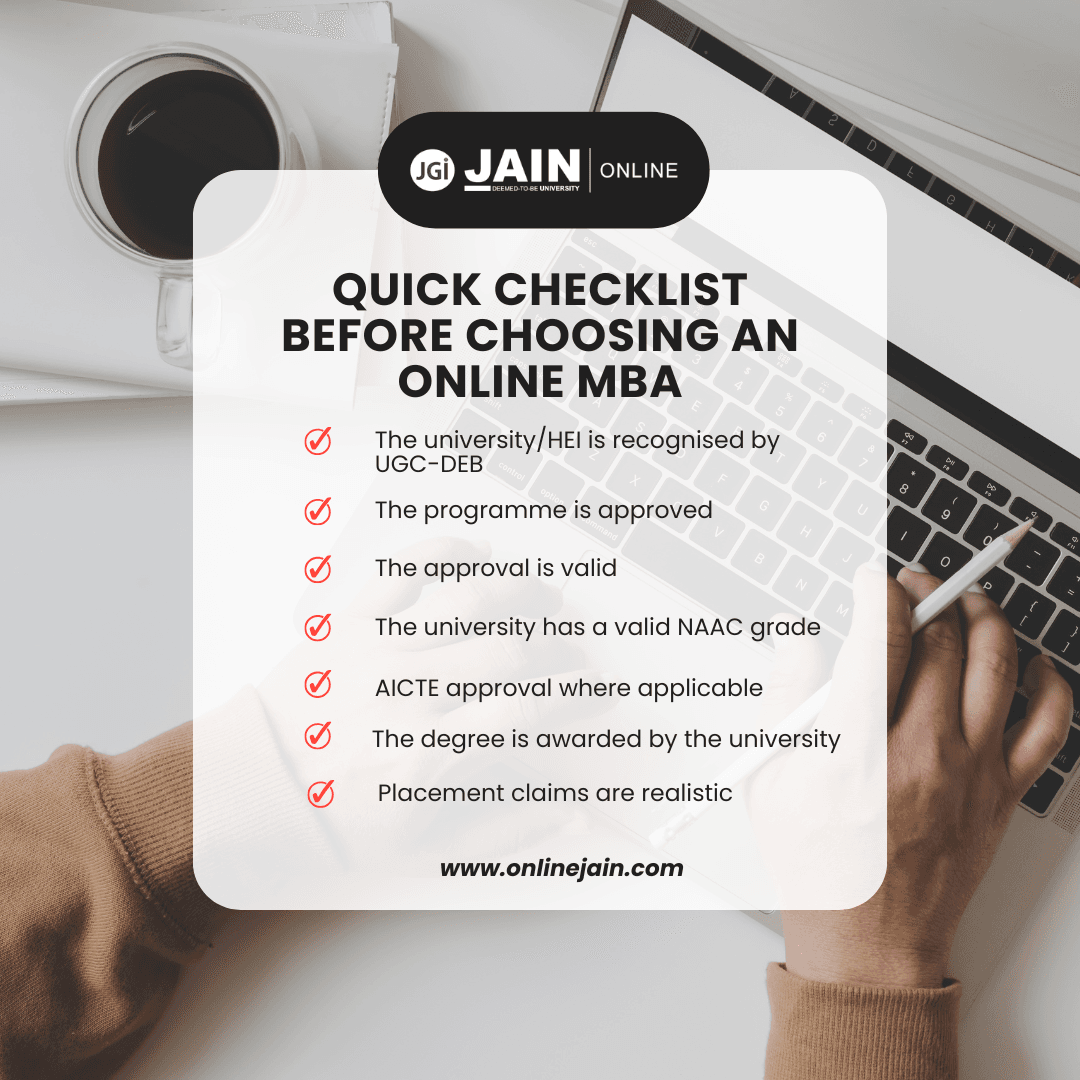
Reputation is multi-dimensional. A lesser-known programme with outstanding pedagogy, industry ties, and strong alumni engagement may better serve your niche goals than a famous name with a misaligned curriculum. Calibrate to your function, geography, and time horizon.
Why this matters:
- Accreditation supports employer confidence and may influence eligibility for certain roles or internal sponsorships.
- It can affect credit transfer, international recognition, and pathways for further study.
- It’s a signal of curriculum review cycles, faculty qualifications, and assessment integrity.
Always verify accreditation on the official websites of the respective bodies and the institution. If a programme markets itself as “accredited,” ensure you understand precisely which body has accredited which component.
What Should A Strong Online MBA Programme Include?
A strong online MBA programme is designed for outcomes, not just convenience. It should combine structured learning, practical application, and career readiness. The best programmes are built specifically for online delivery, not simply recorded classroom lectures.
Here’s what to look for:
- Structured learning paths with clear progression from fundamentals to advanced topics
- A mix of live (synchronous) and recorded (asynchronous) sessions
- Applied learning through projects, case studies, and simulations
- Regular assessments that test real-world understanding, not just theory
- Career support, including mentorship, CV reviews, and interview preparation
- Active peer interaction through group work and discussions
A high-quality online MBA should help you build skills, not just earn a degree.
Flexibility And Convenience: How Online MBAs Work
Flexibility is one of the biggest advantages of an online MBA, especially for working professionals in India. Most programmes offer:
- Asynchronous learning: Recorded lectures and self-paced modules that fit around your schedule
- Live sessions: Interactive classes for discussions, case analysis, and Q&A
- Modular structure: Options to customise electives or pace your learning
- Anywhere access: Study from any location without relocation or commuting costs
However, flexibility only works if you create structure. To stay on track:
- Block fixed study hours in your calendar
- Break assignments into weekly milestones
- Attend at least one live session per week
- Build one networking touchpoint weekly (LinkedIn, alumni, or peer interaction)
Consistency is what turns flexibility into career outcomes.
Integration Of Virtual Learning Experiences
Top online MBA programmes go beyond lectures, creating immersive learning environments. These experiences help you build decision-making, leadership, and collaboration skills.
Look for:
- Case simulations and role plays that mimic real business scenarios
- Breakout sessions for small-group discussions and teamwork
- Virtual labs using tools like Excel, analytics platforms, or product frameworks
- Capstone projects solving real or realistic business problems
- Peer feedback systems that improve communication and leadership skills
Many programmes also include guest lectures, industry panels, and virtual networking events. These can be highly valuable if you actively participate and follow up with connections.
Online MBA Curriculum: What You Study And How You Learn
Curriculum matters because it decides whether an online MBA gives you only a qualification or real workplace value. A strong programme should combine core management subjects, role-relevant electives, applied projects, and structured assessments that demonstrate your ability to apply what you learn. Expect a scaffolded progression from foundations to integrative leadership.
A typical structure includes:
- Core courses: Accounting, finance, marketing, operations, strategy, economics, organisational behaviour, and analytics.
- Electives: Specialisations that let you go deeper in target domains.
- Workshops and labs: Communication, negotiation, design thinking, data visualisation, or product discovery.
- Projects and capstones: Individual or team-based, often tied to real business cases or your current workplace.
Delivery methodologies range from fully online to blended formats with optional or required in-person residencies. Assessment may include quizzes, written assignments, case analyses, open-book exams, proctored tests, presentations, and peer evaluations. What to look for:
- Live touchpoints with faculty: Regular opportunities to ask questions and get feedback.
- Structured peer collaboration: Cohort-driven assignments and clear team contracts to mirror workplace dynamics.
- Transparent rubrics and grading: Clear expectations and timely feedback loops.
- Academic integrity mechanisms: Proctored exams or robust assessment design that emphasises applied understanding.
Programmes that balance theory (frameworks and models) with practice (simulations, projects, tools) tend to deliver better transfer to the workplace (one of the biggest advantages of learning while you’re working).
Why Specialisations Matter When Deciding If An Online MBA Is Worth It
Specialisations help define your career direction and signal your expertise to employers. Choosing the right specialisation can significantly impact your job opportunities and growth.
Popular online MBA specialisations include:
- Finance: Corporate finance, investment analysis, risk management
- Marketing: Digital marketing, brand strategy, consumer insights
- Operations and Supply Chain: Logistics, sourcing, process optimisation
- Business Analytics: Data analysis, predictive modelling, decision-making
- Product Management: Product strategy, roadmapping, experimentation
- Human Resources: Talent management, organisational design, people analytics
- Strategy and Leadership: Business strategy, innovation, leadership skills
- Entrepreneurship: Startup management, funding, go-to-market strategies
- Technology Management: IT strategy, digital transformation
- Sector-focused tracks: Healthcare, sustainability, public policy
Selection tip: Choose a specialisation that aligns with both your strengths and market demand. If you are planning a career switch, support your specialisation with projects, certifications, and practical experience to improve credibility.
Is An Online MBA Worth It For You in 2026?
Yes, if the programme is credible, current, flexible and practical enough to help you move closer to your next role in your job or open up new opportunities for you.
An online MBA is worth it when it fits your career stage, budget, learning style, and long-term goals. Before choosing a programme, check whether it offers recognised academic value, practical business skills, credible assessments, relevant specialisations, and career support that goes beyond placement claims.
A strong choice blends accreditation, curriculum relevance, schedule fit, cohort diversity, faculty quality, and meaningful career support. Look for programmes that clearly show outcomes, highlight real student work (portfolios, capstones), and are transparent about how learning and evaluation happen.
Ask yourself:
- Is the programme recognised and credible?
- Does the curriculum include current business, digital and analytical skills?
- Does the specialisation support my target role or industry?
- Can I manage the course alongside work or other commitments?
- Will I get live faculty support, feedback and structured assessments?
- Does the programme include projects, simulations or capstones?
- Is there meaningful career support and alumni access?
- Does the total cost make sense for my expected career growth?
- Am I ready to network, build a portfolio and actively apply what I learn?
For working professionals, the biggest advantage of an online MBA is continuity. You can keep your job, apply concepts in real time, and use measurable outcomes to support promotions, role changes, or salary discussions.
For freshers, the decision depends on expectations. If you want campus life and structured placement drives, a regular MBA may suit you better. If you want flexibility, affordability, and early skill-building while gaining work experience, an online MBA can still be a practical option.
For career switchers, an online MBA works best when backed by proof of skill. Relevant specialisations, practical projects, certifications, internships, or workplace assignments can help employers clearly understand your transition.
So, is an online MBA worth it in 2026? The answer depends on disciplined programme selection and deliberate career execution. For many Indian professionals seeking to balance growth with stability, a well-chosen online MBA can offer both momentum and measurable returns.
Fast-Track Your Career With JAIN Online
JAIN Online offers 7 UGC-entitled online degrees across 30+ specialisations, backed by JAIN (Deemed to be University), which is NAAC-accredited with an A++ grade. AICTE also approves its BBA, MBA, BCA, and MCA programmes. The learning model includes flexible online delivery, AI fluency through 30+ tools, micro-credentials built into every semester, access to 100+ advanced courses, and 20,000+ LinkedIn Learning courses. Its learner network spans 8,000+ corporates, 21 industries and 45+ countries, while reported outcomes include 2,000+ hiring corporates, 15,454+ jobs facilitated, a 65% average salary hike, a 78% career success rate and an 84% course completion success rate.
FAQs
Which Is Better In 2026: A Regular MBA Or An Online MBA?
A regular MBA is better if you want campus immersion, peer learning and structured placement drives. An online MBA is better if you are working, need flexibility and want to keep earning while studying. The better choice depends on your career stage, availability of time, budget, and target role.
Which Online MBA Specialisation Is Best For Career Growth In 2026?
The best online MBA specialisation depends on your target role. Business analytics, finance, marketing, product management, operations, HR analytics and technology management are strong options in 2026. Choose a specialisation that matches your strengths, industry demand and the role you want after graduation.
Is An Online MBA Good For Freshers Or Experienced Professionals?
An online MBA is usually more valuable for working professionals because they can apply concepts immediately at work. Freshers can also benefit from using the programme to build business knowledge, gain internships, complete projects, and earn certifications. However, freshers expecting a campus-style placement experience may prefer a regular MBA.
Can I Switch Careers After An Online MBA?
Yes, an online MBA can support a career switch, but the degree alone may not be enough. Career switchers should choose a relevant specialisation, complete practical projects, and build evidence of their skills through internships, certifications, freelance work, or workplace assignments.
How do career opportunities differ between online and on-campus MBAs in India?
Top on-campus MBAs offer centralised, intensive placement seasons with multiple recruiters. Online MBAs emphasise continuous career enablement—CV support, interview prep, job boards, industry projects, and decentralised networking through cohorts and alumni communities.
Who is a better fit for an online MBA versus an on-campus programme?
Professionals with 3–10 years of experience, as well as entrepreneurs and family business owners seeking immediate, practical application, often benefit from an online MBA. Freshers aiming for brand-heavy campus placements and a first big jump may find on-campus programmes more advantageous.
How Important Is UGC Approval For An Online MBA?
UGC approval is very important for an online MBA in India. It shows that the programme is recognised under the required regulatory framework. Students should verify the university, programme name, delivery mode and current approval status before enrolling.
How do Indian employers view online MBAs?
Employers are becoming more skill-focused in 2026. They look beyond the degree and assess digital fluency, business judgement, communication, analytics, leadership readiness and practical project work. An online MBA is more credible when it comes from a recognised institution and helps you show evidence of applied learning.
What should I look for in a high-quality online MBA programme?
Prioritise recognised accreditation, an updated curriculum covering digital, analytics, and product, and strong career services with employer outreach. Look for live industry projects or capstones, active alumni networks, and flexible delivery with robust student support.
How much does an online MBA Cost In India?
Online MBA fees in India vary by university, specialisation, delivery model and support services. Many online MBA programmes cost less than full-time campus MBAs because learners avoid relocation, hostel, commuting and career-break costs. Students should compare total cost, not just tuition fees.
Is An Online MBA Accepted For Government Jobs?
An online MBA may be accepted for government jobs if the degree is from a recognised university and the programme has the required approvals. Eligibility depends on the specific job notification, so students should check whether the recruiting body accepts the degree, mode and institution.
How can I maximise ROI from an online MBA while working?
Align projects and electives with your target roles, build a portfolio, and actively network through cohorts, alumni, and LinkedIn. Apply on-the-job learning to demonstrate impact and leverage continuous career support for CV refinement and interview readiness.
Who Should Not Choose An Online MBA?
An online MBA may not be ideal for learners who need daily in-person interaction, campus life or a highly structured placement environment. It may also be difficult for students who struggle with self-paced learning. If you need constant classroom accountability, a regular MBA may suit you better.
Related Blogs
 Programs
Top Interview Questions for Social Media Roles
The role of a Social Media Manager is essential in today’s digital-first world. Whether you're a beginner, intermediate-level professional, or a senior candidate, excelling in a social media manager interview requires preparation, creativity, and strategic thinking.
Read More → Programs
Top Interview Questions for Brand Manager Roles
Brand management is a dynamic and strategic role that involves building, maintaining, and growing a brand's image and market presence. Companies seek brand managers who can blend creativity with data-driven decision-making.
Read More → Programs
Why Marketing Leadership Needs Digital-Savvy Professionals
In today’s fast-paced and ever-evolving business landscape, marketing leadership demands more than just traditional expertise. As technology continues to reshape industries, the need for digital-savvy marketing professionals has become a critical success factor for organizations worldwide.
Read More →