
 Admission
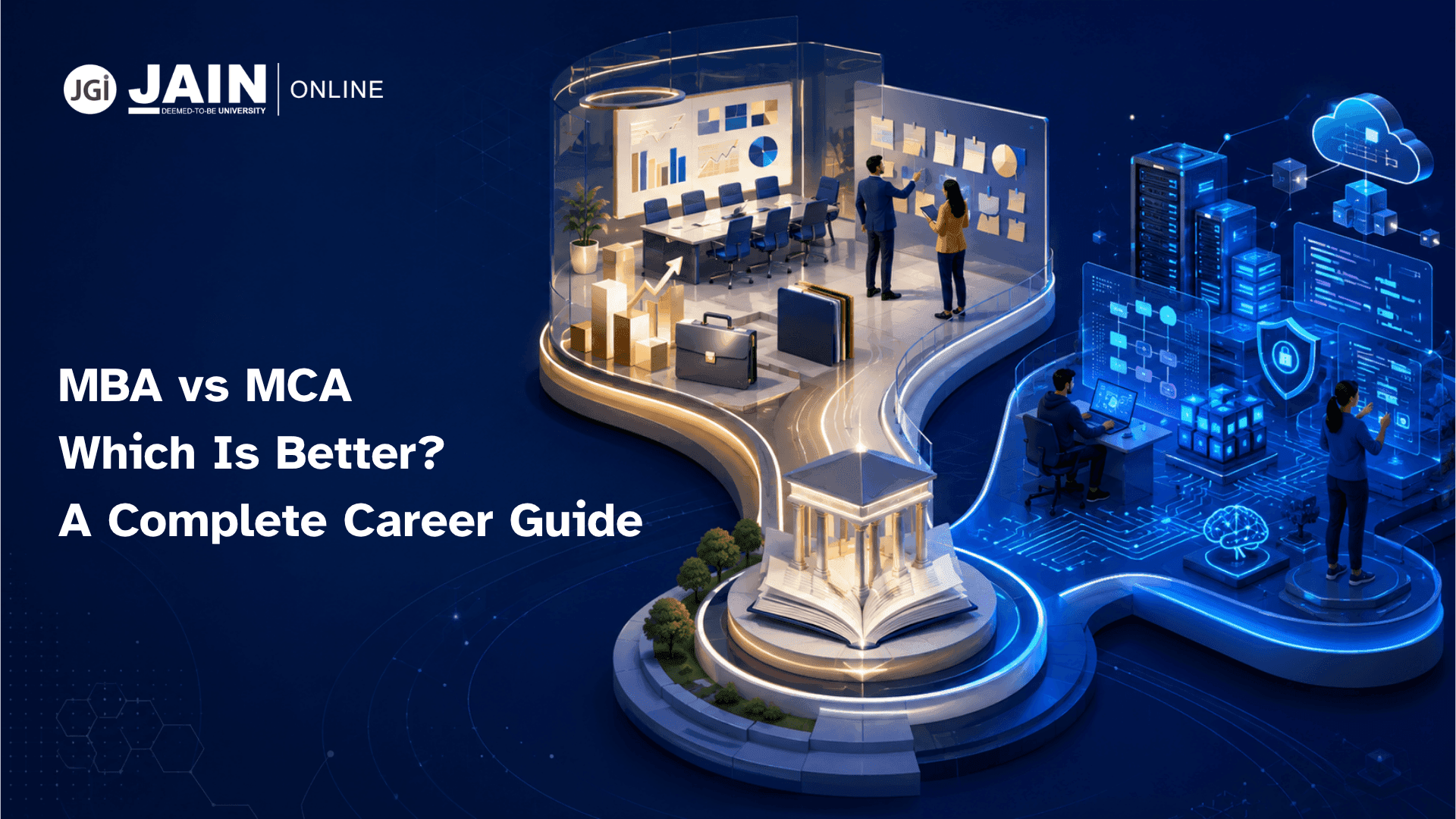
MBA vs MCA - Which Is Better? A Complete Career Guide
MBA or MCA, which is better, depends on the career you want to build. An MBA is better if you want to move into business, management, marketing, finance, HR, operations, consulting, product, entrepreneurship or leadership roles. An MCA is better if you want a technical career in software development, programming, cloud, data, cybersecurity, AI, automation or IT systems.
Neither course is better for everyone. Your choice should depend on your academic background, comfort with coding, interest in business, salary expectations, preferred work style and long-term career direction.
This guide compares MBA vs MCA across eligibility, skills, career opportunities, salary potential, ROI, industry demand, future scope and the best choice after BCA, BSc, BTech, commerce, arts or general graduation.
MBA or MCA: Which Is Better for Your Career?
MBA and MCA are both respected postgraduate programmes in India, but they prepare students for different types of work. An MBA builds business and leadership capability across strategy, marketing, finance, HR, operations, analytics and organisational growth. An MCA builds technical depth in computer applications, programming, software development, databases, cloud computing, cybersecurity, and emerging technologies.
Choose an MBA if you enjoy business problems, communication, leadership, revenue growth, market strategy, product thinking, or people management. Choose an MCA if you enjoy coding, debugging, system design, databases, software development, data systems and technical problem-solving. The better option is not the one with the higher general popularity. It is the one that matches the work you want to do every day.
MBA vs MCA - a Quick Comparison
Use this quick comparison to understand whether an MBA or MCA is better aligned with your career goals, academic background, and preferred work style.
What Is an MBA and Who Should Choose It?
An MBA is a management-focused postgraduate degree for students and professionals who want to build business, leadership and decision-making skills. It prepares learners for roles across marketing, finance, HR, operations, analytics, consulting, product management, entrepreneurship and general management.
Choose an MBA if you:
- Want to lead teams, manage products, shape strategy, or build a business?
- Are curious about markets, customers, pricing, and revenue growth.
- Enjoy communication, stakeholder management, and decision-making under uncertainty.
- Plan to move into roles like product manager, consultant, marketing manager, financial analyst, operations manager, HR manager, or business analyst.
- See yourself starting a company or managing a P&L in the future.
In short, an MBA is better for learners who want to manage business functions, lead teams, work with customers or clients, build strategy, improve operations, or take ownership of growth outcomes.
What Do Students Learn In An MBA?
While curricula vary by university, most MBA programmes develop a broad business toolkit and the ability to operate across functions. Typical learning areas include:
- Business strategy: Competitive positioning, growth frameworks, and strategic planning.
- Marketing: Consumer behaviour, digital marketing, brand strategy, and go-to-market planning.
- Finance: Financial accounting, corporate finance, budgeting, and valuation basics.
- HR: Talent acquisition, performance management, culture, and organisational behaviour.
- Operations: Supply chain, process optimisation, quality, and service design.
- Analytics: Business analytics, dashboards, forecasting, and data-driven decision-making.
- Leadership: Team dynamics, influence, change management, and ethics.
- Communication: Presentations, storytelling with data, and stakeholder communication.
- Decision-making: Scenario analysis, risk management, and managerial economics.
- Entrepreneurship: Opportunity assessment, product/market fit, and business model design.
Many programmes also include internships, live projects, case studies, and simulations that teach you how to think like a manager under real-world constraints.
What Is an MCA and Who Should Choose It?
An MCA is a technical postgraduate degree for students who want deeper expertise in computer applications, programming, software engineering, and IT systems. It is a strong fit for learners who want to build software, work with data, manage databases, develop applications, understand cloud systems, or move into cybersecurity and emerging technology roles.
Choose an MCA if you:
- Like writing code, debugging, and building end-to-end software solutions.
- Want to work in software development, systems design, data engineering, or cloud.
- Prefer technical depth over general management.
- Enjoy solving algorithmic problems and optimising performance/security.
- Aim for roles such as software developer, full-stack developer, systems analyst, data analyst, cloud engineer, cybersecurity analyst, database administrator, or application developer.
In short, MCA is better for learners who want to stay close to technology, write code, build applications, solve technical problems and grow through specialised IT skills.
What Do Students Learn In An MCA?
MCA programmes emphasise computer science fundamentals applied to real-world development. Typical learning areas include:
- Programming: Mastery of multiple languages and paradigms.
- Software development: SDLC, version control, testing, and deployment practices.
- Database management: Relational and NoSQL databases, transactions, and optimisation.
- Data structures: Algorithms, complexity, and performance considerations.
- Cloud computing: Foundational concepts for deploying and scaling applications.
- Artificial intelligence: Basics of machine learning and intelligent systems (often elective).
- Cybersecurity: Secure coding, vulnerabilities, and protection strategies.
- Web and app development: Front-end, back-end, and mobile stacks.
- System design: Fundamentals of Architecture, APIs, microservices, and distributed systems fundamentals.
- Data analytics: Data pipelines, visualisation, and entry-level analytics workflows.
Capstone projects, internships, and hackathons reinforce hands-on practice and teamwork.
MBA vs MCA: Career Opportunities And Industry Demand In India
Both degrees lead to strong outcomes, just in different directions. Companies hire MBA graduates to build markets, grow revenue, manage operations, and drive strategy. They hire MCA graduates to build the products, platforms, and data pipelines that power digital businesses. In a growing, tech-enabled economy, demand for both management and technology roles remains resilient, though the nature of entry roles, growth curves, and required skill stacks differs.
Below are the top jobs and growth trends for each track, including the best career options after an MBA and after an MCA.
What Are The Best Career Options After an MBA?
MBAs usually enter through management trainee programmes, analyst roles, or direct-entry functional positions, then grow into leadership. Best Career Options After MBA include:
- Marketing Manager: Owns brand positioning, digital channels, campaigns, and customer acquisition.
- Financial Analyst: Works on financial planning, budgeting, risk assessment, and investment analysis.
- HR Manager: Leads talent acquisition, learning and development, and performance management.
- Operations Manager: Improves processes, supply chains, and service delivery.
- Business Analyst: Translates business needs into requirements and enables data-driven decision-making.
- Product Manager: Sits at the intersection of business, tech, and UX to build products customers love.
- Sales Manager: Drives revenue via account management, channel partnerships, and field sales.
- Consultant: Solves complex business problems across strategy, operations, and transformation.
- Entrepreneur: Launches products, startups, or service ventures; builds teams and systems from zero.
Growth trends for MBA graduates:
- Cross-functional roles are on the rise, especially at the intersection of analytics and business.
- Digital marketing, product management, and business analytics are increasingly popular specialisations.
- Organisations value MBAs who can execute, not just strategise, practical experience, internships, and certifications matter.
- Career acceleration is often faster for those who build strong presentation, negotiation, and stakeholder management skills.
Overall, MBA careers are broad and flexible; your specialisation and internships often determine your first role, but your leadership potential drives long-term growth.
What Are The Best Career Options After MCA?
MCA graduates step into hands-on roles where technical depth is the differentiator. Best Career Options After MCA include:
- Software Developer: Builds, tests, and maintains software modules and services.
- Full Stack Developer: Works across the front end and back end to ship end-to-end features.
- Data Analyst: Cleans, analyses, and visualises data to inform decisions.
- Systems Analyst: Bridges business requirements with technical solutions and system design.
- Cloud Engineer: Manages cloud deployments, scalability, and infrastructure-as-code.
- Cybersecurity Analyst: Monitors, detects, and mitigates security threats and vulnerabilities.
- Database Administrator: Designs, tunes, and secures databases; ensures high availability.
- IT Consultant: Advises on architecture, tooling, integration, and digital transformation.
- Application Developer: Creates and maintains mobile or enterprise applications.
Growth trends for MCA graduates:
- Demand for full-stack, cloud, and data roles remains strong due to ongoing digital transformation.
- DevOps, SRE, and platform engineering skills add high value to core development expertise.
- Cybersecurity and privacy-by-design are becoming essential in many sectors.
- Continuous learning- new languages, frameworks, and tools-directly influences employability and progression.
An MCA career is great for those who prefer technical mastery, systematic problem-solving, and building reliable, scalable systems.
MBA vs MCA: How Career Growth Differs in India
Both MBA and MCA graduates are in demand in India, but for different types of roles. MBA graduates are hired for business growth, revenue, marketing, finance, HR, operations, consulting, product, analytics and leadership tracks. MCA graduates are hired for roles in software development, cloud computing, cybersecurity, data analytics, automation, AI-enabled systems, and IT infrastructure.
MBA may offer faster movement into managerial and leadership roles if you build strong communication, stakeholder management, business analytics and execution skills. MCA may offer strong technical growth if you build depth in programming, system design, data, cloud, cybersecurity, or AI-related skills.
The better growth path depends on your strengths. MBA supports business leadership growth. MCA supports technical specialists and technology leadership growth.
MBA vs MCA: Key Differences In Career, Skills and Growth
Comparing MBA vs MCA means comparing business leadership capabilities with the depth of technical problem-solving. Both are valuable; their fit depends on your profile. An MBA positions you for roles where communication, market understanding, and organisational leadership create value. An MCA positions you for roles where code, architecture, and data systems create value.
Key differences:
- Entry roles: MBAs enter business functions; MCAs enter development/technical functions.
- Career arcs: MBAs often move toward people leadership and P&L responsibility; MCAs often progress to senior engineer, architect, or technical manager roles.
- Skill stacks: MBAs emphasise strategy, communication, and stakeholder influence; MCAs emphasise algorithms, system design, and implementation rigour.
- Risk/reward: MBA outcomes vary with institute brand, internships, and soft skills; MCA outcomes vary with technical skill depth, project portfolio, and adaptability to new tools.
Neither is universally “better.” The best choice is the one that aligns with your strengths and the type of problems you enjoy solving daily.
Which Industries Hire MBA Graduates?
MBA graduates are hired across industries where business growth, revenue, operations, finance, and people management are important. Common industries include:
- Banking and financial services
- Consulting
- FMCG and retail
- IT and technology services
- E-commerce and startups
- Healthcare and hospital administration
- EdTech
- Manufacturing and logistics
- Real estate and infrastructure
- Media, marketing, and advertising
MBA graduates usually work in roles across marketing, finance, HR, operations, sales, analytics, product, and strategy.
Which Industries Hire MCA Graduates?
MCA graduates are hired across industries where software, data, cloud, cybersecurity, and digital systems are central to business operations. Common industries include:
- IT services
- Software development companies
- SaaS and product companies
- FinTech
- EdTech
- Healthcare technology
- E-commerce
- Cybersecurity firms
- Cloud and infrastructure companies
- Data analytics and AI-led companies
MCA graduates usually work in roles across software development, full-stack development, cloud engineering, database management, cybersecurity, data analytics, and application development.
MBA Or MCA: Which Is Better After BCA, BSc, BTech, or Graduation?
Your undergraduate background influences the smoother next step, but should not limit your ambition. The right path depends on your comfort with coding vs business, your communication strengths, your desired work style, and your target industry. If you enjoy software development, MCA aligns your current foundation with advanced skills. If you want to pivot to business-facing roles, an MBA creates that bridge. Below are practical guidelines for UG backgrounds.
MBA Or MCA: Which Is Better After BCA?
After BCA, the natural progression is MCA if you want to deepen technical skills and aim for developer, data, cloud, or cybersecurity roles. Choose MCA if you enjoy coding, debugging, building applications, and solving engineering problems daily.
Consider an MBA after BCA if you want to pivot into product management, business analytics, marketing, sales, operations, or tech-enabled business roles. Your tech literacy can be a major advantage in roles that sit at the intersection of business and engineering, such as product or business analyst positions.
MBA Or MCA: Which Is Better After BSc?
For BSc Computer Science or BSc IT graduates, an MCA is generally better for a technical career in software development, data engineering foundations, or system analysis. Your technical fundamentals will be strengthened by MCA’s hands-on training.
If your BSc is in a non-IT stream and you want business-facing roles (marketing, finance, HR, analytics, or hospital administration), an MBA can be a better choice. If you are comfortable with numbers and communication, an MBA opens multiple functional doors, from sales and marketing to operations and consulting-like roles.
MBA Or MCA: Which Is Better After BTech Or BE?
Engineering graduates can choose an MCA only if they want deeper expertise in computer applications and plan to stay in software-centric roles. However, many BTech/BE graduates already meet the technical depth needed for software roles and may prefer specialised certifications or on-the-job learning instead of an MCA.
Choose an MBA if you want to transition from purely technical work into management, consulting, product management, operations, or business leadership. Your engineering background plus an MBA’s business toolkit can be a powerful combination for cross-functional roles.
MBA Or MCA: Which Is Better After Commerce Or Arts Graduation?
MBA is usually a more suitable option for commerce, arts, and general graduation students because it opens roles in business, management, marketing, HR, finance, and operations. If you are comfortable with communication, analytical reasoning, and teamwork, an MBA provides a clearer path to growth in diverse industries.
Choose MCA only if you already have a strong foundation in programming and meet the eligibility criteria. Without prior technical grounding, the learning curve can be steep, delaying outcomes unless you are highly motivated and prepared to invest in significant upskilling.
MBA vs MCA Eligibility, Duration And Admission Requirements
MBA and MCA are both postgraduate programmes, but their eligibility requirements are different. MBA eligibility usually requires a recognised bachelor’s degree, minimum marks as per the university or entrance exam rules, and, in many cases, an accepted entrance exam score. MCA eligibility usually requires a recognised bachelor’s degree and is more suitable for learners with mathematics, computer applications, IT, computer science or engineering backgrounds.
In India, many MBA and MCA programmes are offered in two-year formats, but eligibility, entrance exams, approval status and admission rules can vary by university, state and programme type. Students should always verify the latest criteria on the official university, entrance exam or regulatory website before applying.
Entrance pathways typically include national-level tests, state-level exams, or university-level assessments, followed by group discussions and personal interviews. Work experience can help, particularly for MBA applicants, but is not always mandatory.
MBA Eligibility In India
- Bachelor’s degree from a recognised university.
- Minimum marks as per institution requirement.
- Entrance exams like CAT, MAT, XAT, CMAT, NMAT, or university-level tests.
- Some colleges may prefer work experience, but it is not always mandatory.
Shortlisting often includes written ability tests, group discussions, and interviews. Strong communication skills, leadership exposure, internships, and extracurriculars can strengthen your profile.
MCA Eligibility In India
- Bachelor’s degree from a recognised university.
- Mathematics at the 10+2 or graduation level is commonly preferred or required for MCA admission, depending on the university, entrance exam and applicable admission rules. Students without a mathematics background may need bridge courses where permitted by the institution.
- BCA, BSc IT, BSc Computer Science, BTech, or related backgrounds are usually more aligned.
- Entrance exams may vary by university or state.
In addition to academic eligibility, your project portfolio, programming proficiency, and performance in interviews and coding assessments often influence admission and placement opportunities.
MBA vs MCA Salary And ROI Comparison In India
MBA vs MCA salary comparison depends on the institute, location, job role, skill level, internships, projects, placement support and prior experience. MBA salaries may grow faster in consulting, finance, product, analytics, marketing and leadership roles. MCA salaries may grow strongly in software development, cloud, cybersecurity, AI, data and full stack development roles.
Neither degree guarantees a high salary. ROI improves when the programme matches your strengths and you build proof of skill through internships, projects, certifications, portfolios and measurable work outcomes.
Think of ROI as a function of three inputs: the ability to land a good first role, the pace of skill growth, and long-term fit. If you’re aligned with your programme’s core work-managing and selling for MBA, coding and engineering for MCA-you improve ROI significantly.
What is the Salary Potential after an MBA In India?
High ROI MBA paths usually include:
- Finance
- Marketing
- Business analytics
- Product management
- Consulting
- Operations
- Digital business
What drives better outcomes for MBA graduates:
- Institution reputation, alumni network, and placement ecosystem.
- Internships that show measurable impact (e.g., increased leads, improved unit economics).
- Certifications and projects in analytics, digital marketing, or product tools.
- Strong communication: clear writing, persuasive presentation, and stakeholder management.
- Early responsibility-owning targets, processes, or small teams.
Graduates who demonstrate execution alongside strategy often progress faster into roles with higher responsibility and corresponding compensation.
What Is the Salary Potential After an MCA in India?
High ROI MCA paths usually include:
- Software development
- Cloud computing
- Data science
- AI and ML
- Cybersecurity
- Full-stack development
- DevOps
What drives better outcomes for MCA graduates:
- Strong fundamentals in data structures, algorithms, and system design.
- Portfolio of projects (open-source contributions, apps, websites, ML models).
- Certifications in cloud, security, or data engineering are relevant.
- Internships or freelance work that proves problem-solving in production environments.
- Continuous learning to adapt to new frameworks, tools, and best practices.
Technical excellence compounds-MCA graduates who keep shipping high-quality work steadily move into senior engineering and architecture roles with strong compensation growth.
Which Has Better ROI, MBA Or MCA?
Neither degree guarantees ROI; both can deliver strong returns when aligned with your strengths and executed with discipline. In general:
- MBA may offer better ROI for students who want leadership, business, and managerial growth-especially those who excel at communication, networking, and owning business outcomes.
- MCA may offer better ROI for students who enjoy coding, problem-solving, and technical roles-especially those who build a standout portfolio and keep upgrading their skills.
To improve ROI in either path, choose a reputable programme, maximise internships and projects, build proof of work, and target roles where your skills create measurable impact.
MBA vs MCA ROI Comparison
ROI depends on how well the programme matches your strengths, career goals, skills, projects, and long-term growth path.
Skills Required For Success In MBA And MCA Programs
Success in either programme depends on building the right habits early. For MBA, that means learning to communicate clearly, analyse data, and influence stakeholders. For MCA, that means writing a lot of code, mastering fundamentals, and building a portfolio. In both cases, internships, projects, and peer learning accelerate outcomes.
Skills Required for MBA and MCA
MBA and MCA programmes build different skill sets. An MBA focuses more on business, leadership, and decision-making, while an MCA focuses more on technical problem-solving, coding, and systems thinking.
Common Skills That Help In Both MBA And MCA Careers
Some skills are useful in both MBA and MCA careers because modern roles often combine business thinking with technology awareness. Students from both programmes should build:
- Analytical thinking
- Problem-solving
- Communication
- Teamwork
- Project management
- Data interpretation
- Adaptability
- Time management
- Presentation skills
- Continuous learning
Practical Tip
Build proof of skill while you study. MBA students can create case studies, presentations, market research projects, and business plans. MCA students can build apps, coding projects, GitHub portfolios, and technical case studies. In both paths, internships, live projects, and measurable outcomes make your profile stronger than coursework alone.
Factors To Consider Before Choosing Between MBA And MCA
Before choosing between an MBA and an MCA, compare the course with your real career direction, not just market trends. A degree works best when it matches your strengths, work style, academic background and willingness to build the skills required for that path.
Use the checklist below to align your choice with reality-not hype.
- Your academic background: Technical foundations make MCA smoother; business/economics exposure makes MBA easier. Both are possible with effort.
- Your interest in business or technology: Do you prefer marketing plans and financial models, or designing systems and writing code?
- Your comfort with coding: If you enjoy it and can do it for hours daily, MCA fits. If not, consider an MBA.
- Your communication and leadership skills: If you like presenting, persuading, and leading groups, an MBA plays on those strengths.
- Your salary expectations: Compensation grows with impact. MBAs often move faster into management; MCAs compound through technical mastery.
- Your preferred job role: Product/marketing/finance/HR/operations vs software/cloud/data/security.
- Your target industry: Banking, FMCG, e-commerce, or consulting may favour MBA; SaaS, IT services, and cloud-native companies may favour MCA.
- Your budget and expected ROI: Institute brand, placements, and internships significantly influence outcomes. Compare realistic costs with likely entry roles.
- Your willingness to build extra skills: Analytics and product tools help MBAs; cloud, DevOps, and security add value for MCAs.
- Your long-term career goal: Leadership and P&L vs technical architecture and engineering leadership.
When in doubt, talk to seniors in roles you aspire to, check the skills they use daily, and match your day-to-day preferences with the work you will actually do.
What Are the Future Growth Options After an MBA and an MCA?
Both degrees open multiple pathways for further growth and specialisation.
Future Growth Options After MBA
MBA graduates can grow by deepening their functional expertise, building leadership capability, and moving into roles that involve business ownership or strategic decision-making.
- Specialisations: Deepen in marketing, finance, analytics, operations, HR, or product.
- Certifications: Analytics tools, digital marketing platforms, financial modelling, or project management.
- Advancement: Management roles, business unit ownership, product leadership, or entrepreneurship.
- Later education: Executive MBA or focused executive programmes to refine leadership and strategy.
Future Growth Options After MCA
MCA graduates can grow by strengthening technical depth, building specialised skills, and moving towards senior engineering or technology leadership roles.
- Specialisations: Cloud, cybersecurity, data engineering, DevOps, or AI/ML (with further learning).
- Certifications: Cloud provider tracks, security certifications, database and DevOps certifications.
- Advancement: Senior developer, tech lead, architect, engineering manager, or platform specialist.
- Later education: Research or specialised master’s programmes, depending on goals.
Can MBA And MCA Career Paths Overlap?
Yes, MBA and MCA career paths can overlap in roles that connect business and technology. MCA graduates can move into product management, IT consulting, business analysis, or tech leadership with business exposure. MBA graduates can enter product, analytics, digital business, or tech-enabled leadership roles by learning the basics of technology. This overlap is valuable because companies need professionals who can align business goals with digital solutions.
Final Verdict On MBA Or MCA: Which Is Better For You?
MBA is better if your goal is business, management, leadership, marketing, finance, HR, operations, consulting, product, entrepreneurship, or strategy. MCA is better if your goal is software development, coding, IT, data science, cloud computing, cybersecurity, AI, automation, or technical problem-solving.
If you thrive on communication, influencing outcomes, and owning business metrics, choose an MBA. If you love building systems, writing code, and solving engineering challenges, choose MCA. Both paths can deliver strong careers when matched to your strengths and supported by projects, internships, practical skills, and continuous upskilling.
The better course is not the one with the highest general salary claim. It is the one that matches your strengths, academic background, interests, skill-building capacity, and long-term career direction.
Take the Next Step With JAIN Online
If you are comparing MBA and MCA options, JAIN Online offers flexible online degree programmes designed for learners who want to build career-relevant skills without pausing work or personal commitments.
Whether you want to move towards management through an online MBA or strengthen your technology pathway through an online MCA, JAIN Online allows you to compare programme structures, learning formats, specialisations and career alignment before making your decision.
Explore JAIN Online MBA and MCA programmes, compare your options and choose the path that supports your next career step.
Frequently Asked Questions (FAQs)
1. MBA or MCA, which is better in India?
An MBA is better suited to careers in business, management, leadership, marketing, finance, HR, consulting, and entrepreneurship. MCA is better for software development, data, cloud, cybersecurity, AI, and core IT roles. The right choice depends on whether you want a business career or a technology career.
2. What is the main difference between MBA and MCA?
The main difference between an MBA and an MCA is their career focus. An MBA builds business, leadership, strategy, finance, marketing, and people management skills. MCA builds technical skills in programming, software development, databases, cloud, cybersecurity, and computer applications.
3. Who should choose an MBA after graduation?
Choose an MBA after graduation if you want to enter business, management, marketing, finance, HR, operations, consulting, product management, or leadership roles. It suits students who enjoy communication, strategy, decision-making, teamwork, and business problem-solving.
4. Who should choose MCA after graduation?
Choose MCA after graduation if you want a technical career in software development, IT, data, cloud, cybersecurity, or application development. It is best for students who enjoy coding, logical thinking, debugging, system design, and solving technology problems.
5. MBA or MCA, which is better after BCA?
MCA is usually better after BCA if you want to continue in coding, software development, data, cloud, cybersecurity, or core IT roles. MBA is better after BCA if you want to shift towards management, product, business analytics, sales, marketing, consulting, or leadership.
6. MBA or MCA, which is better after BSc?
MCA is better after BSc Computer Science, BSc IT, or a related technical degree if you want a software or IT career. MBA is better for general BSc graduates who want business, management, healthcare administration, analytics, operations, or leadership roles.
7. MBA or MCA: which is better after graduation?
MBA is better after graduation if you want to build a career in business, management, marketing, finance, HR, operations, consulting, product, or leadership roles. MCA is better if you want a technical career in software development, IT, data, cloud, cybersecurity, or application development. The right choice depends on your graduation background, skills, and career goal.
8. MBA or MCA, which has a better salary in India?
MBA and MCA can both lead to strong salaries, but in different fields. MBA salaries are stronger in consulting, finance, product, marketing, analytics, and leadership roles. MCA salaries grow well in software development, cloud, cybersecurity, AI, data, and full-stack development.
9. Is an MCA better than an MBA for IT jobs?
MCA is better than an MBA for core technical IT jobs such as software development, application development, database management, cloud, cybersecurity, and data roles. MBA is better for IT management, product management, business analysis, technology consulting, sales, and leadership roles in tech companies.
10. Which is better for the future, an MBA or an MCA?
Both MBA and MCA have strong future scope, but the better option depends on your career goal. MBA is better for business growth, leadership, strategy, and management careers. MCA is better for software, data, cloud, cybersecurity, AI, automation, and technical careers.
Related Blogs
 Admission
Best Courses After 12th Commerce for Students Without Maths
If you’re a Commerce student without Maths, you may be wondering about the scope of options available to you after the 12th. The good news is that there are numerous rewarding
Read More → Admission
Top Degree Courses to Consider After 12th: A Guide for Students
The crucial step in every student's life after 12th will be choosing the right degree course for their academic journey. The courses chosen by each student
Read More → Admission
What is the Scope of Human Resource Management (HRM)?
Human Resource Management (HRM) is the strategic approach to managing people effectively in an organization. HRM has evolved from traditional personnel management to a dynamic function that significantly influences organizational success.
Read More →