
 General
After BBA, Which Course Is Best? 8 Options in India (2026)
There is no single best course after BBA. An MBA may suit graduates seeking broader management learning, while finance-focused learners may consider the CFA or an M.Com; technology-oriented graduates may evaluate analytics pathways and, where eligible, consider an MCA. An LLB can suit those planning a legal career. The right choice depends on eligibility, target role, budget and preferred study format.
You finished your BBA and now face a crucial decision: choose a pathway that supports your career goals, fits your budget and time horizon, and matches your strengths. This guide compares eight practical courses and qualifications that BBA graduates can consider in India, including their typical purposes, eligibility requirements, time commitments, and possible career paths.
Top 8 Courses to Consider After BBA
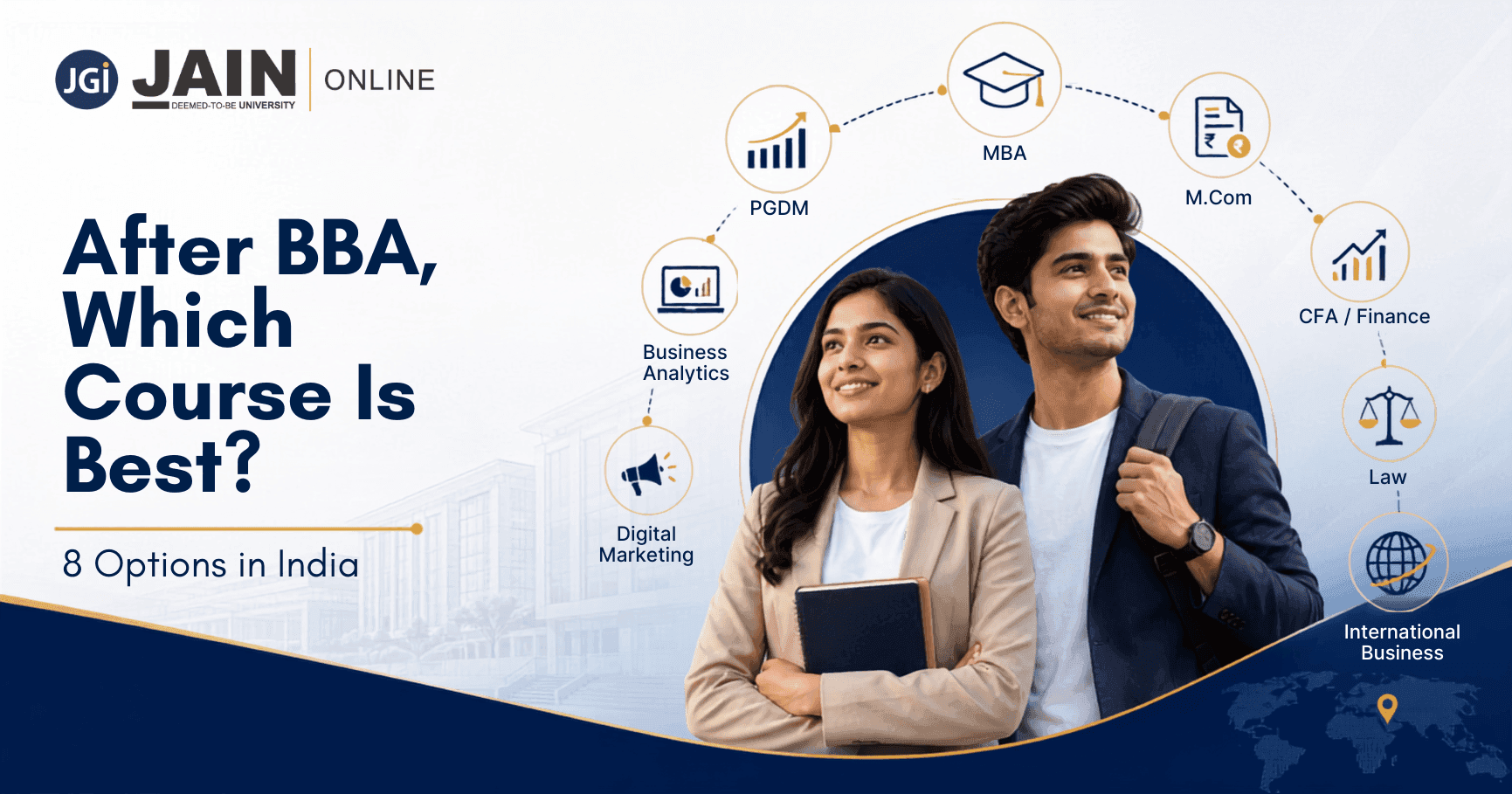
This numbered list compares practical options BBA graduates can explore based on career direction, qualification type, time commitment and eligibility. Short descriptions below will help you quickly identify which options deserve a deeper read based on your goals.
- MBA (Master of Business Administration) - Broad postgraduate management pathway covering multiple business functions
- PGDM (Post Graduate Diploma in Management) - Postgraduate management diploma whose structure and emphasis vary by institute.
- Master’s Programmes in International Business - For careers in global trade, exports, and international marketing.
- CFA (Chartered Financial Analyst) - A specialised professional qualification for learners interested in investment analysis, portfolio management and related finance fields.
- Data Analytics and Business Analytics Courses - For data-driven roles: analysts, BI, analytics consultants.
- Digital Marketing Certification - Skill-focused pathway covering areas such as digital advertising, SEO, content and analytics.
- LLB (3-year Bachelor of Laws) - Combine business and legal expertise for corporate law, compliance, and contracts.
- M.Com (Master of Commerce) – Postgraduate commerce pathway for learners interested in finance, accounting and related business areas.
Read the full breakdown for each course below to compare duration, cost, entry routes, sample career paths, and when each option is likely the best fit.
1. MBA (Master of Business Administration)
An MBA is one of the most common postgraduate options BBA graduates consider to deepen their knowledge of management and their chosen business area. It builds strategic thinking, people management, and business problem-solving in a 2-year full-time programme. For many BBA graduates, an MBA is a natural step because it expands core business foundations and can support progression towards management, specialist or cross-functional roles, depending on prior experience, skills and employer requirements.
Who it's best for: BBA graduates who want managerial careers, responsibility for cross-functional teams, or roles such as Business Analyst, Product Manager, Operations Lead, or Marketing Head. If you are considering a campus MBA, compare the institution’s recruitment model, curriculum, total cost, specialisations, and published career support information.
Duration: Typically 2 years for full-time programmes. Executive or part-time formats offer flexibility but take longer.
Elective options: Marketing, Finance, Human Resources, Operations, Systems/IT, Strategy, Business Analytics, International Business. Choose a specialisation that matches both interest and demand. For example, analytics-focused study may suit learners interested in data-led business decisions, while marketing, finance, HR and operations support different functional pathways.
Entrance exams: CAT, XAT, CMAT, MAT, NMAT, and various state-level CETs. Many colleges also use group discussions and personal interviews.
Fees range: MBA fees vary significantly by institution, learning mode and programme structure. Compare tuition and any additional charges alongside the curriculum, recognition, learning format and available career support. Do not assume that a higher fee will automatically result in a higher salary or stronger placement outcome.
Career outcomes: MBA graduates often move into roles like Business Analyst, Product Manager, Marketing Manager, Finance Manager, HR Lead, Operations Manager, and Management Consultant. Career progression after an MBA depends on the learner's prior experience, skills, specialisation, programme quality, role fit and employer requirements.
ROI considerations: Break-even depends on fees, pre-MBA experience, and placement package. For fresh BBA graduates, Campus recruitment may provide a structured route to employers, although outcomes vary by institution, candidate profile, role and market conditions. An MBA can add management knowledge, professional networks and role-relevant skills, but career progression depends on the programme, prior experience, individual performance and employer requirements.
Practical tips:
- Compare institutions based on curriculum, recognition, total cost, learning format and published career support information.
- Choose a specialisation that supports the type of work you want to pursue and complements your existing strengths.
- Start entrance-exam preparation early and follow the latest syllabus, eligibility rules and test format.
JAIN Online MBA after BBA: BBA graduates who meet the eligibility criteria can consider JAIN Online’s two-year, four-semester MBA. The current programme includes elective pathways across areas such as Finance, Marketing, Human Resource Management, General Management, Business Intelligence and Analytics, Data Science and Artificial Intelligence, Digital Marketing and e-Commerce, and other business domains. Applicants should compare the latest curriculum, elective structure, fees and admission requirements before applying.
The current eligibility requires a bachelor's programme of at least three years in any stream from a UGC-recognised university, with a minimum aggregate of 50% or equivalent grade; there is a 5% relaxation for SC/ST candidates. Final-semester bachelor's students may also apply.
2. PGDM (Post Graduate Diploma in Management)
A PGDM is a postgraduate management diploma. Curriculum, programme duration, admission requirements, recognition, practical exposure and career support vary by institution, so compare the specific programme before applying.
Who it's best for: Graduates aiming for industry entry in roles like Project Manager (entry-level), Business Development Manager, Sales Lead, or Operations Supervisor where practical skills and modern tools matter. If you prefer a curriculum that adapts faster to market trends, consider PGDM.
Duration: Usually 1-2 years depending on the institute and whether it's a full-time or executive format.
Placement focus and curriculum: PGDM often emphasises case studies, internships, live projects, and guest lectures from industry practitioners. Institutes typically include resume coaching, interview prep, and networking to support placements.
Fees and entrance: Fees vary by institute and can be comparable to those of MBA programs at many private colleges. Entrance tests are often college-specific; many PGDM schools accept scores from national tests such as CAT or CMAT, while others conduct their own selection processes.
Career outcomes: Roles include Project Coordinator, Business Development Executive, Client Relationship Manager, Operations Executive, and mid-level management roles in startups and SMEs. PGDM curricula that are updated frequently can give graduates an edge in fast-moving sectors such as e-commerce and digital services.
Practical tips:
- Check an institute's industry partners and placement statistics before enrolling; these are often more telling than fees alone.
- Shorter, intense PGDMs are useful if you want to re-enter industry quickly rather than spending two years on a full-time MBA.
- Consider the PGDM institute's alum network and regional recruiter base for long-term mobility.
3. Master’s programmes in International Business
Master’s programmes in International Business suit BBA graduates planning careers in international trade, exports, global supply chains, and cross-border marketing. The programmes cover foreign exchange management, international trade regulations, export-import procedures, and global market strategies, which complement a BBA's business fundamentals.
Who it's best for: Graduates aiming for roles like International Marketing Manager, Trade Analyst, Export Manager, Global Supply Chain Specialist, or positions in multinational corporations handling cross-border operations.
Duration: Typically 2 years. Some institutes offer one-year advanced diplomas or specialised certificates for quicker entry.
Core skills taught: International trade regulations, foreign exchange management, international marketing, cross-cultural management, global logistics, free trade agreements, and country risk assessment. Practical exposure often includes case studies on market entry, export documentation, and trade finance.
Career paths: International Marketing Manager, Export-Import Manager, Trade Compliance Officer, Global Sourcing Analyst, Cross-border Business Development Lead, and roles in trade advisory and government trade bodies.
Practical tips:
- Look for MIB programmes that include internships with export houses, trading firms, or multinational supply chain functions.
- Basic business-level proficiency in a foreign language can be a differentiator for international roles.
- Build familiarity with trade documentation and digital trade platforms. Practical competence matters more than theoretical grades in this domain.
4. CFA (Chartered Financial Analyst)
The CFA is a globally recognised credential for finance professionals and is well-suited to BBA graduates who want deep, technical finance expertise. The programme is rigorous, with multiple exam levels, and is respected by investment banks, asset managers, equity research firms, and financial advisory firms.
Who it's best for: BBA graduates who want careers in investment banking, portfolio management, equity research, corporate finance, and financial analysis roles that demand strong quantitative and valuation skills.
Duration and commitment: CFA is a professional qualification rather than a master's degree. CFA Institute sets eligibility, examination structure, fees, and experience requirements, which may change, so applicants should verify the latest requirements through the official source before registering.
Skills acquired: Financial statement analysis, equity and fixed-income valuation, derivatives, portfolio management, quantitative methods, and professional ethics. The CFA sharpens financial modelling and valuation skills that are valued in high-finance roles.
Cost vs ROI: CFA is comparably low-cost compared with full-time master's programmes, but it requires sustained time and intense study. Employers in finance regard the credential well; securing top-tier banking roles often also depends on internships and networking alongside the CFA.
Practical tips:
- Pair CFA study with internships in finance to build practical experience. The CFA alone is rarely enough for immediate access to top front-office roles.
- Start early: CFA Level I can be attempted during or soon after your BBA if you are comfortable with quantitative subjects.
- Consider a specialised Master's in Finance if you prefer structured classroom learning over self-paced exam prep.
5. Data Analytics / Business Analytics Certification or Master’s
Data analytics courses after a BBA are well-suited to graduates who enjoy working with numbers and want to combine business acumen with technical skills. Programmes range from short certifications (6-12 months) to full M.Sc. or specialised master's degrees in Business Analytics. They leverage a BBA's quantitative background and prepare you for data-driven roles.
Who it's best for: BBA graduates aiming for roles such as Data Analyst, Business Intelligence Analyst, Analytics Consultant, Market Research Analyst, or positions where business problems are solved using data tools and statistical reasoning.
Duration: Options include short-term certifications (6-12 months) focused on tools and practical projects, and 1-2 year master's programmes that combine depth with academic rigour.
Key skills: Excel and advanced spreadsheet modelling, SQL for databases, Python or R for analytics, visualisation tools (Tableau, Power BI), statistical concepts, A/B testing, and business storytelling with data. Employers value candidates who can translate analytics into business decisions.
Career relevance: Analytics skills can be applied in business functions that involve data interpretation, reporting and decision-making. Specific roles and hiring requirements vary by employer, industry and candidate experience.
What to compare in a programme: Consider recognised university master's programmes for deep learning and research pathways. For immediate job readiness, look for bootcamps and certificate programs that offer placement support and live projects using real datasets. In many cases, a combination of a solid portfolio (Kaggle projects, internships) plus certification works best.
Practical tips:
- Build practical evidence through analytics projects, dashboards, case studies, or, where possible, work with suitable datasets.
- Focus on SQL and one scripting language (Python or R) - they are essential for analytics hiring in India today.
- If time permits, a 1-2 year master’s programme provides stronger theoretical backing.
6. Digital Marketing Certification
Digital marketing courses are skill-focused options for learners interested in areas such as paid media, SEO, content, e-commerce and analytics. Their career value depends on the programme, practical experience and the learner’s ability to demonstrate relevant skills.
Who it's best for: BBA graduates who enjoyed marketing subjects, creative campaigns, or content strategy, or who want to work in startups and agencies. Digital marketing also suits those seeking freelance or remote work with flexible income potential.
Duration: Typically 3-6 months for intensive certifications. Longer advanced certificates and diplomas run 6-12 months.
Key skills: SEO basics, Google Ads (PPC), Facebook/Instagram ads, content strategy and copywriting, analytics (Google Analytics), email marketing automation, basic design tools, and conversion optimisation. Practical experience running campaigns is critical.
Job roles: Digital Marketing Executive, SEO Specialist, PPC Analyst, Social Media Manager, Content Strategist, Growth Marketer. Freelancing and agency roles are common and often enable rapid income growth tied to performance metrics.
Practical tips:
- Build a live portfolio: run small ad campaigns with personal or local-business budgets to show ROI-driven results.
- Certifications from recognised platforms (Google, Meta, HubSpot) add credibility, but practical results matter most.
- Digital marketing pairs well with an MBA or PGDM specialisation in marketing if you plan to pursue leadership roles later. Start with certification to test fit quickly.
7. LLB (3-year Bachelor of Laws)
Pursuing a 3-year LLB after BBA gives you legal knowledge that complements business training. It's valuable if you want to specialise in corporate law, compliance, contract management, or become in-house counsel. Combining commercial understanding from a BBA with legal skills makes you attractive to corporations, legal consultancies, and compliance functions.
Who it's best for: Graduates interested in corporate law, regulatory compliance, contract negotiation, dispute resolution, or advisory roles where legal and business decisions intersect.
Duration: 3 years (standalone LLB after graduation).
Careers: Legal Advisor, Corporate Counsel (after additional licensure or practice), Compliance Officer, Contract Manager, or roles in legal consultancies and regulatory bodies. LLB graduates can also combine the degree with an MBA or a PGDM later to gain hybrid expertise.
Admission basics: Many universities conduct entrance tests and evaluate academic records. Practical experience through internships at law firms, legal clinics, or corporate legal departments is crucial for employability.
Why strategic with a BBA: Your business background helps you understand commercial contexts for legal issues, making you a stronger candidate for in-house counsel and compliance roles compared with candidates who have only legal education.
Practical tips:
- Seek internships in corporate legal teams early to apply business knowledge to legal practice.
- A BBA background may provide useful commercial context for learners studying business-related areas of law.
- Consider additional courses in corporate governance or compliance to sharpen your edge for corporate roles.
8. Master of Commerce (M.Com)
An M.Com is a postgraduate option for BBA graduates seeking to deepen their knowledge in areas such as accounting, finance, taxation, investment, financial analysis, and corporate reporting. It can be especially relevant for learners who want to strengthen their foundation in finance and commerce before moving into finance, banking, accounting, consulting, or related business roles.
Who it's best for: BBA graduates interested in finance, accounting, financial analysis, taxation, investment, banking, or corporate finance. It may also suit learners who want a more specialised commerce-focused postgraduate degree rather than a broader management programme.
Duration: Typically 2 years. JAIN Online's M.Com is a 2-year postgraduate programme divided into 4 semesters.
Eligibility: At JAIN Online, applicants must have completed a bachelor's programme of at least 3 years in any stream from a UGC-recognised university. Candidates in the final semester of their bachelor's programme are also eligible to apply.
Elective options: Depending on the university, M.Com programmes may offer different finance and accounting-focused tracks. JAIN Online currently offers electives in AI for International Finance, Accounting and Finance, and International Finance.
Career outcomes: An M.Com can support career pathways across areas such as accounting, finance, banking, financial analysis, investment-related functions, taxation, and corporate finance. Actual roles and progression depend on the learner's skills, prior experience, specialisation, and employer requirements.
ROI considerations: Compare the programme fee, curriculum, elective options, study format, and relevance to your target role before deciding. An M.Com may be more suitable for learners seeking deeper study in commerce and finance, while an MBA may suit those seeking broader management education.
Practical tips:
- Choose an M.Com elective that matches your long-term finance or accounting career goal.
- Compare the curriculum with what you studied during BBA to identify areas where you want deeper specialisation.
- If you are deciding between an MBA and an M.Com, consider whether you want broad management learning or a more focused finance-and-commerce pathway.
How to Choose the Right Course After BBA
Choosing among these options requires a clear decision framework. Think about short-term goals (first job, income needs), long-term goals (leadership, specialisation), and the gap between your current skills and what employers expect. Below are practical evaluation criteria to help you decide.
Key factors to evaluate
Use these factors as a checklist when comparing courses after a BBA. They help you move from general preference to a specific, actionable choice.
Personal Interests and Strengths
Identify which business areas you genuinely enjoy: marketing, finance, HR, operations, analytics, or law. Match likely daily tasks to your natural skills. For example, if you enjoy public speaking and negotiation, sales and marketing or an MBA with a marketing focus may fit. If you prefer numbers and structured problem-solving, finance or data analytics may be a better match. Honest self-assessment often beats trends for long-term satisfaction and performance.
Further Education vs. Direct Employment
Decide whether you want immediate work experience or an advanced qualification. Direct employment gives practical learning and networking you can leverage for a later MBA or PGDM as an experienced candidate. Further education like an MBA, MIB, or a master's is ideal if you need formal credentials to reach target roles quickly. A sensible hybrid is a 6-12 month certification (analytics, digital marketing) to enter the workforce, gain one year of experience, and then re-evaluate larger degrees like an MBA.
Financial Goals and Budget
Balance immediate income needs with long-term earning potential. Compare tuition and additional costs with your available budget and the relevance of the programme to your intended career direction. If studying requires a career break, include lost income and other opportunity costs in your calculation. Avoid assuming that a higher-priced qualification will automatically result in a higher salary.
Job Market Demand and Growth
Review current job descriptions for the roles you are interested in and identify recurring qualification, technical-skill and experience requirements. Use those requirements to assess whether a course addresses a genuine gap in your profile. Traditional functions like finance, HR, and operations remain steady but can be competitive. Choose courses that keep you employable in growing sectors while leveraging your BBA foundation.
Work Environment and Lifestyle
Consider the type of employer and work-life balance you want: corporate roles often mean predictable office hours and hierarchical growth; startups can be fast-paced with broader responsibilities and more variable hours. Some careers (consulting, sales) involve travel, while analytics and digital roles can offer remote options. Match the course to the lifestyle you want, not only to salary or prestige.
Checklist: Time, Cost and Career Fit
Compare course duration, tuition and additional costs, any income you may forgo while studying, and the relevance of the qualification to your intended career direction. Financial returns vary by programme, learner profile, role and market conditions.
Use this prioritised checklist:
- What is the full cost of the programme?
- How much time can you realistically commit?
- Does the curriculum address skills relevant to your intended role?
- What recognition or eligibility requirements apply?
- What career-support services does the provider actually publish?
- What practical work or portfolio evidence can you build during the programme?
Checklist: Skill fit and interest
Map required skills for your target role against your current skills. Identify gaps in technical skills (SQL, Python), domain knowledge (financial modelling, trade regulations), or soft skills (client communication, negotiation). If the gap is mainly technical, short-term certifications or bootcamps often suffice. If the gap is strategic or leadership-focused, consider a 2-year master's degree like an MBA or an M.Com.
Postgraduate Options at JAIN Online after BBA
Eligible BBA graduates can consider JAIN Online postgraduate programmes based on their intended career direction. The current Online MBA is a two-year, four-semester programme for eligible graduates and includes multiple management and domain-focused elective pathways. JAIN Online also offers a two-year M.Com, with academic eligibility requiring a bachelor’s programme of at least three years in any stream, and a two-year MCA for applicants with a minimum three-year bachelor's degree in any stream who meet the programme's stated marks and other eligibility requirements.
What Should You Check When Comparing Online and Campus Programmes?
Online programmes have matured, but their weight compared to campus programmes depends on context. For entry-level hiring, employers often prioritise demonstrable skills and internships more than delivery mode. For senior leadership roles, the reputation of the awarding institution, the alum network, and the depth of learning matter more than whether the programme was online.
In many scenarios, an online course that offers strong practical projects, industry-relevant curriculum, and placement can be as effective as a campus programme for early-career roles, particularly in data analytics, digital marketing, and some technical finance roles. For traditional corporate leadership tracks, campus MBAs and PGDMs from established institutes still carry stronger placement networks and brand value.
Key considerations for online programmes:
- Accreditation and institutional reputation: prefer recognised universities or well-known bootcamps with proven placement records.
- Practical projects and mentorship - ensure the programme includes live projects, capstones, and career services.
- Networking opportunities - online cohorts and alums groups can be valuable; check active engagement levels.
When Can Short-Term Certifications and Skill Courses Be Useful After BBA?
Short-term courses can help BBA graduates develop specific skills, but they do not guarantee employment, promotion or faster career growth. They are especially effective for gaining job-ready skills in analytics, digital marketing, HR technologies, and specific software tools. Short certifications are best when your goal is quick entry into the workforce or immediate skill upgrades for a promotion.
When short certifications work best:
- You already have a business foundation (like a BBA) and need specific technical skills (SQL, Google Ads, Tableau) to qualify for roles.
- Employers value demonstrable results (campaign metrics, dashboards, models) more than degrees for the role.
- You want to test a career path quickly before committing to a longer degree (for example, analytics versus MBA).
When a long-form degree is preferable:
- You aim for leadership tracks that require cross-functional exposure and networking (senior management, consulting, top-tier investment banking).
- You need a recognised credential to unlock higher-level opportunities quickly (for example, a campus MBA from a top institute).
Recommended durations and sample credentials:
- 3-6 month bootcamps: Digital marketing, SEO, PPC, basic analytics - high immediate employability if paired with portfolio work.
- 6-12 month certificates: Business analytics, advanced digital marketing, product management foundations - good mix of depth and speed.
- 1-2 year master’s: For deeper analytics or research-heavy roles (M.Sc. in Data Analytics, MIB, MMS) - better for long-term growth and higher starting roles.
Next Steps: Recommended Path Based on Career Goal
The following examples show how different course types can align with common career interests. They are decision frameworks rather than guaranteed career sequences.
If you want corporate leadership / general management:
- Option A: Direct MBA from a recognised institute. Prepare for entrance tests (CAT/XAT/CMAT) and target institute shortlists based on ROI and placement records.
- Option B: Work 1-2 years in a business role, then apply for an MBA as an experienced candidate to access higher leadership roles and scholarships.
If you want a high-growth analytics or product role:
- Complete a 6-12 month data analytics certification with live projects and build a portfolio.
- Gain 1 year of experience as a Data Analyst or BI Analyst, then consider a master’s in Business Analytics or an MBA with analytics specialisation for senior roles.
If you want a finance-first career (investment banking, research):
- Start CFA Level I alongside internships in finance. Combine with a certificate in financial modelling.
- Work for 1-3 years in finance roles, then decide between CFA completion or a specialised Master in Finance for faster access to front-office roles.
If you want marketing or digital roles quickly:
- Do a 3-6 month digital marketing certification (SEO, PPC, analytics) and run real campaigns for a live portfolio.
- Enter the workforce as a Digital Marketing Executive or join an agency; after 2-3 years, consider an MBA/PGDM in marketing to advance to leadership roles.
If you want international business careers:
- Pursue MIB or a specialised international trade programme and complement it with internships in export houses or multinational corporations.
- Consider short-term language training to increase suitability for international postings.
If you want legal and compliance roles:
- Enroll in the 3-year LLB and intern with corporate legal teams or compliance departments.
- After the LLB, combine experience with a compliance certification or an MBA in corporate governance if aiming for senior in-house counsel roles.
Which Course Should You Choose After BBA?
There is no single best course after BBA for every graduate. An MBA may suit learners who want broader management education, while M.Com can be relevant for those seeking deeper study in commerce and finance. Professional qualifications, analytics courses, digital marketing programmes and law pathways serve different career interests and require different levels of time, cost and commitment.
Before choosing, compare the programme's eligibility, curriculum, qualification type, recognition, total cost, learning format and relevance to the work you want to pursue. Avoid making the decision based solely on advertised salaries, placement claims, or course popularity.
Eligible BBA graduates can also explore postgraduate options at JAIN Online, including MBA, M.Com, and MCA programs, subject to applicable eligibility requirements and their preferred career direction.
Take the Next Step With JAIN Online
If you are planning further studies after a BBA, JAIN Online offers postgraduate pathways in management, commerce, and technology for eligible graduates. You can explore the two-year Online MBA with multiple elective options, the two-year M.Com for deeper learning in finance and commerce, or the two-year MCA if you meet its eligibility requirements and want to build more technology-focused capabilities. Compare the curriculum, eligibility, elective options and programme structure to identify the pathway that best aligns with your interests and career direction.
Explore JAIN Online postgraduate programmes, check your eligibility and choose a learning pathway aligned with your goals.
Frequently Asked Questions (FAQs)
Q1. Which short-term courses can I consider after BBA?
BBA graduates can explore skill-focused courses in areas such as analytics or digital marketing when these align with their career goals. Duration, cost, curriculum and employment outcomes vary by provider, so compare individual programmes rather than assuming that a shorter course guarantees faster employment.
Q2. What factors should I consider when choosing between an MBA and a PGDM after a BBA?
An MBA is a postgraduate degree, while a PGDM is a postgraduate diploma. Recognition, curriculum, admission process, learning format, fees and career support vary by institution, so compare the specific programmes you are considering.
Q3. Is CFA a viable option after BBA for India-based finance careers, and what does it involve?
CFA is a professional finance qualification rather than a general management degree. Learners should verify the latest eligibility, examination structure, fees and experience requirements directly through the official professional body before applying.
Q4. Can a degree in LLB be pursued after BBA, and what career paths does it open?
BBA graduates may explore graduate-entry law programmes where they meet the applicable eligibility requirements. Admission, programme duration, and professional practice requirements should be verified with the university and the relevant regulatory authorities.
Q5. How does Data Analytics or Business Analytics certification compare with an MBA in terms of time, cost, and job prospects?
Analytics certificates and master's programmes differ from an MBA in scope, qualification type, duration and curriculum. Analytics study is more focused on data-led skills, while an MBA typically covers broader management areas. Compare individual programmes rather than assuming one route offers better job prospects.
Related Blogs
 General
Can I Do BCA Without Maths in India? Eligibility Guide
BCA without Maths in India eligibility guide by JAIN Online, featuring a student exploring computer applications, coding and higher education opportunities.
Read More → General
Online BBA vs Offline BBA in India: Key Differences
Online BBA vs Offline BBA in India comparison by JAIN Online, showing a student learning on a laptop and another attending classroom sessions, highlighting flexibility, learning experience, cost and career support.
Read More → General
Online MBA Exam Pattern in India: Assessment, Marks and Exam Format
JAIN Online blog banner featuring a woman studying with a laptop and notebook, highlighting Online MBA Exam Pattern in India with assessment, marks and exam format.
Read More →