
 General
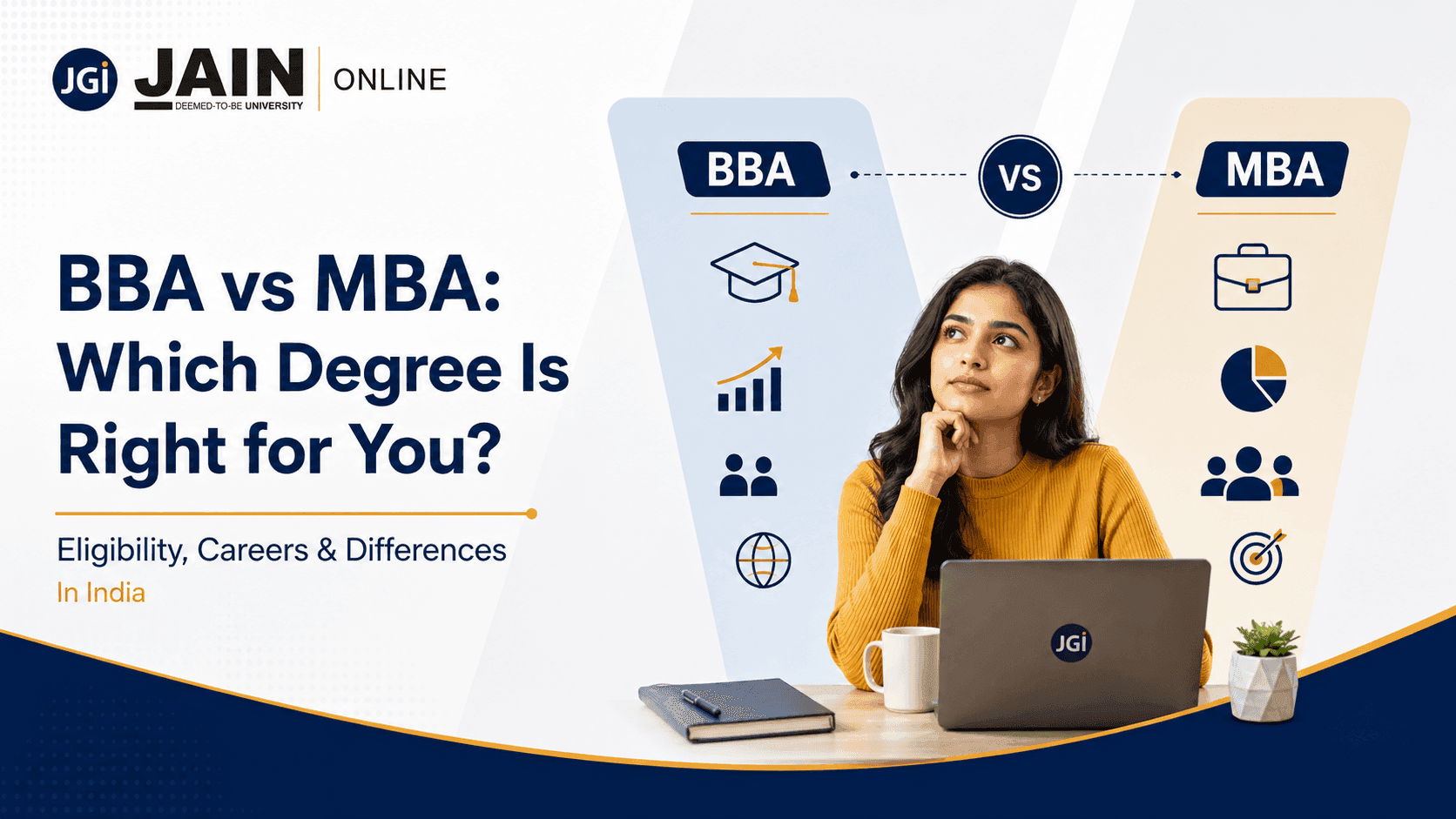
BBA vs MBA: Which Business Degree Is Right for You in India?
BBA and MBA are not equivalent alternatives at the same academic stage. A BBA is an undergraduate business degree for students who have completed Class XII, whereas an MBA is a postgraduate management degree for graduates.
The right choice therefore depends first on eligibility and then on your career stage, preferred learning depth, budget, work experience and intended role. A school leaver may consider a BBA as a first degree, while a graduate or early-career professional may evaluate whether an MBA supports a defined professional goal.
This guide compares BBA vs MBA in India across eligibility, duration, curriculum, learning approach, cost, career relevance and progression options, including when pursuing an MBA after a BBA may make sense.
BBA vs MBA at a Glance
What Is a BBA?
The Bachelor of Business Administration (BBA) is an undergraduate degree that students can pursue after Class XII, subject to the institution's eligibility criteria. It builds foundational knowledge across areas such as finance, marketing, human resources, operations and organisational behaviour. Depending on their goals, graduates may enter early-career roles or continue to postgraduate study, including an MBA.
BBA Curriculum and Learning Focus
A BBA usually builds foundational knowledge across areas such as accounting, economics, marketing, organisational behaviour, operations, business law and analytics. The emphasis is on understanding how key business functions work and developing the academic and practical skills needed for early-career roles or further study. Depending on the institution, learners may also choose electives or specialisations that align with areas such as Finance, Marketing, Human Resource Management, Digital Marketing or Data Science and Artificial Intelligence.
JAIN Online BBA learners can review the current programme curriculum and available elective options to identify areas that align with their interests and career direction.
What Is an MBA?
The Master of Business Administration (MBA) is a postgraduate degree focused on management, decision-making, business strategy and specialisation. Applicants require an undergraduate qualification, although work-experience requirements vary by institution and programme format. Some MBA programmes accept recent graduates, while others prefer or require prior professional experience. An MBA may suit learners who want deeper management knowledge, specialist expertise or preparation for roles with greater responsibility.
MBA Curriculum and Learning Focus
An MBA builds on undergraduate-level knowledge and focuses more deeply on management, strategy, decision-making and specialisation. Core areas commonly include finance and marketing, operations, organisational behaviour, business analytics and strategic management, with elective choices allowing learners to develop greater depth in a particular function or industry.
JAIN Online’s MBA curriculum is structured across four semesters and includes multiple elective pathways, with subjects varying by the chosen area of study.
Key Differences: BBA vs MBA
Below are the most important distinctions between a BBA and an MBA to help you decide based on current career stage and objectives.
Level of Education and Prerequisites
The key distinction is when each degree becomes relevant. A BBA can be pursued after Class XII, subject to institutional eligibility criteria. An MBA requires an undergraduate qualification. This means a Class XII graduate deciding on a first degree would consider a BBA or another undergraduate programme, whereas an MBA becomes an option after completing a bachelor’s degree.
Learning Objectives and Skill Depth
A BBA curriculum emphasises broad functional knowledge and practical skills, including accounting basics, marketing principles and operational understanding. MBA programmes typically place greater emphasis on strategy, specialisation and cross-functional decision-making. In short, a BBA builds broad undergraduate-level business knowledge, while an MBA provides deeper postgraduate management study.
Teaching Methods, Teamwork and Assessment
Teaching and assessment methods vary by institution and programme format. BBA programmes may combine lectures, assignments, projects, presentations and practical activities as learners develop foundational business knowledge. MBA programmes may place greater emphasis on case analysis, group projects, discussions, simulations and applied decision-making. When comparing programmes, review the actual teaching format, assessment structure and opportunities for practical application rather than assuming one learning model applies to every BBA or MBA.
Cost, Timing and Career Return
A BBA usually represents the earlier stage of business education, while an MBA is pursued after completing a bachelor’s degree. The financial decision should therefore consider more than tuition alone. Compare total fees, financing costs, opportunity cost, whether you can continue earning while studying, and how closely the programme aligns with the role or career transition you are targeting.
An MBA can support career progression, but a higher salary, promotion or job change should not be treated as an automatic outcome of completing the degree.
Career Paths After BBA and MBA
Depending on their skills, experience and employer requirements, BBA graduates may explore early-career roles in areas such as business development, marketing, human resources, operations, accounts support or analytics. MBA graduates may explore management, specialist or cross-functional opportunities across areas such as marketing, finance, operations, consulting, product, analytics or human resources.
The difference is not simply that one degree leads to “junior” roles and the other automatically leads to “senior” roles. Career outcomes depend on prior experience, institution, specialisation, practical skills, location, industry, employer requirements and market conditions.
Should You Do a BBA or an MBA? How to Decide
Decide by matching degree outcomes to your current stage, goals and constraints (time, money, appetite for study). Use this framework to choose wisely.
If You Are a School Leaver
If you have completed Class XII and want to build a foundation in business, a BBA is one undergraduate option to consider. It can introduce you to core areas such as finance, marketing, human resources and operations while leaving the option of postgraduate study open later. Compare BBA programmes based on curriculum, elective choices, practical learning opportunities, total fees and your preferred career direction. An MBA becomes an option after you complete an undergraduate degree and meet the programme's eligibility criteria.
If You Are an Early-Career Professional
If you already have work experience, consider whether continuing to work, pursuing a full-time MBA or studying through an online or part-time format best fits your goal. Professional experience can help you identify the function or specialisation you want to pursue and may be relevant where experience forms part of the programme's selection criteria. A full-time programme usually requires a greater break from employment, while an online or part-time format may allow you to continue working. Compare curriculum, learning format, career support, cost and employer requirements before deciding.
Dual-Degree and Progression Options
A common progression is BBA → work experience → MBA, although students who meet the relevant eligibility criteria may also pursue an MBA directly after graduation. Integrated BBA and MBA programmes are available at some institutions, but their structure, duration and exit options vary. Compare these routes based on your career goals, cost, programme structure and whether gaining professional experience before postgraduate study would be useful for you.
Admissions, Costs and Scholarships in India
Admissions processes and costs vary across BBA and MBA programmes in India. Reviewing eligibility criteria, selection requirements, programme fees and available funding options early can help you plan applications more effectively.
BBA Admissions and Eligibility
BBA admission requirements vary by institution. Applicants generally need to have completed Class XII (10+2) from a recognised board and meet the institution's minimum academic criteria. Some institutions admit students based on Class XII results, while others may use aptitude tests, interviews or additional selection stages. Check the official admissions requirements and application deadlines of each programme before applying.
MBA Admissions and Entrance Exams
MBA admissions vary by institution and programme format. Some campus-based programmes use entrance examinations such as CAT, XAT or CMAT along with institution-specific selection processes. Other MBA programmes may admit applicants based primarily on academic eligibility. Check the official admissions requirements of each programme to determine whether an entrance test, interview, work experience or other selection criterion applies.
Scholarships, Funding and Total Cost
Scholarships, education loans, EMI options and employer sponsorship may be available depending on the institution and applicant profile. Do not compare programmes using tuition alone. Check registration, examination and other mandatory charges, financing costs, scholarship conditions and refund policies before estimating the complete amount payable.
Practical Next Steps and Resources
Actionable steps and resources to research programmes, prepare for applications, and make financially sound decisions.
Checklist: Research, Applications and Timeline
Step-by-step guidance:
- Clarify your goal: Decide whether you need an undergraduate foundation in business, deeper postgraduate management study or expertise in a particular business function.
- Research programmes: Review course catalogues, career-support information, alumni profiles and elective options at institutions you are considering.
- Prepare for admission requirements: Check whether your target programme requires an entrance examination, interview or another selection process and prepare accordingly.
- Plan your finances: Compare tuition, mandatory charges, scholarships, loan terms and repayment scenarios based on what you can realistically afford.
- Prepare your application: Track deadlines, gather the required documents and prepare for any selection stages specified by the institution.
- Build practical experience: Look for internships, projects or relevant work experience where available to strengthen your understanding of your preferred function or industry.
You can also explore JAIN Online programmes to compare available undergraduate and postgraduate options based on your qualification and area of interest.
Suggested Resources and Data Points to Check
When evaluating programmes, check these sources and data points:
- Placement reports (average and median salaries, top recruiters)
- Alumni network strength and industry presence
- Course catalogues and elective availability
- Faculty profiles and research/industry engagement
- Recognition or entitlement where relevant, accreditation and documented industry partnerships
- Recent salary statistics and role distribution for graduates
Cross-check programme claims with independent reviews and current students or alumni to get an accurate sense of outcomes.
Which Is Better: BBA or MBA?
For Class XII graduates who want to study business, a BBA can provide an undergraduate foundation and a route into early-career work or further study. Graduates and early-career professionals should consider an MBA when its curriculum, format, cost and specialisation support a specific professional goal.
Before applying, compare current eligibility, total payable fees, teaching and assessment methods, practical projects, career-support services and programme recognition. The degree title alone does not determine job level, salary or promotion; prior experience, applied skills, interview performance, location and employer requirements remain important.
Compare JAIN Online BBA and MBA Options for Your Current Stage
JAIN Online offers a three-year, six-semester Online BBA for eligible learners entering undergraduate business study and a two-year, four-semester Online MBA for eligible graduates.
Learners should review the current BBA curriculum and available elective options alongside the MBA's management and domain-focused elective pathways. Compare the latest curriculum, total fees, admission criteria and applicable programme recognition or entitlement before enrolling.
Explore the JAIN Online BBA and JAIN Online MBA to compare eligibility, electives and learning structure based on your current qualification and career goal.
FAQs
Q1. Can I pursue an MBA after a bachelor’s degree other than BBA?
Yes. MBA programmes can accept graduates from academic backgrounds other than BBA, subject to their eligibility requirements. For example, the JAIN Online MBA requires a bachelor's programme of at least three years in any stream with a minimum aggregate of 50%, with a 5% relaxation for SC/ST candidates. Always check the current eligibility criteria before applying.
Q2. Is work experience compulsory for an MBA in India?
Not for every MBA. Some programmes accept recent graduates, while others prefer or require professional experience. Work experience can provide useful context for case studies and management discussions, but applicants should check the exact criteria of each programme.
Q3. Should I pursue an MBA immediately after BBA or work first?
Either route may be appropriate. Working first can help you understand your preferred function and choose a more relevant MBA specialisation. Moving directly into an MBA may suit learners who already have a clear goal and meet the programme’s eligibility requirements.
Q4. Is an online BBA or MBA valid in India?
An online degree should be offered by an eligible higher education institution and listed for the applicable academic session and delivery mode. Applicants should verify the institution and programme on the UGC-DEB portal before enrolling.
Q5. What should I compare besides tuition fees?
Compare the complete amount payable, curriculum, elective options, teaching and assessment format, faculty, practical projects, learner support, career-support services, recognition status and the programme’s relevance to your intended role.
Related Blogs
 General
Can I Do BCA Without Maths in India? Eligibility Guide
BCA without Maths in India eligibility guide by JAIN Online, featuring a student exploring computer applications, coding and higher education opportunities.
Read More → General
Online BBA vs Offline BBA in India: Key Differences
Online BBA vs Offline BBA in India comparison by JAIN Online, showing a student learning on a laptop and another attending classroom sessions, highlighting flexibility, learning experience, cost and career support.
Read More → General
Online MBA Exam Pattern in India: Assessment, Marks and Exam Format
JAIN Online blog banner featuring a woman studying with a laptop and notebook, highlighting Online MBA Exam Pattern in India with assessment, marks and exam format.
Read More →