
 Programs
What Is an MBA? Curriculum, Types and Careers
An MBA is more than three letters on a résumé. It is a structured way to learn to analyse business problems, lead teams, communicate clearly, and make decisions under uncertainty. For many learners, it also becomes a platform for career growth, leadership development, entrepreneurship, or a career shift.
This guide explains what an MBA is, how the MBA curriculum is structured, what programme formats are available, how specialisations work, how capstone projects and major projects are completed, and what career outcomes you can expect. It also helps you compare an MBA with other business master’s degrees and decide whether the degree fits your goals, timing, and expected return on investment.
Understanding the MBA Curriculum
An MBA curriculum usually starts with core business subjects and then moves into electives, specialisations, experiential learning, and a final capstone or major project.
The first phase of an MBA is intentionally broad. Most programmes build fluency across accounting, finance, marketing, operations, economics, analytics, leadership, and business ethics. This foundation helps learners understand how different business functions connect and how decisions in one area affect the wider organisation.
After the core, students choose electives that align with their career goals. These electives may be called concentrations, tracks, pathways, or specialisations, depending on the institution. For example, a student may combine strategy with entrepreneurship, analytics with marketing, or finance with product management.
Many MBA programmes also include consulting labs, start-up incubators, industry projects, simulations, communication labs, negotiation workshops, and leadership development modules. These elements help students apply classroom concepts to practical business problems.
Programme formats such as full-time, part-time, online, hybrid, and executive MBA change the pace and delivery style, but the broad structure is usually similar:
- Build the core foundation
- Explore electives and areas of interest
- Apply learning through projects or labs
- Demonstrate integrated business thinking through a capstone, dissertation, or major project
Core Curriculum: Structure and Focus
The MBA core curriculum creates a shared business foundation, enabling professionals from different backgrounds to collaborate and make better managerial decisions.
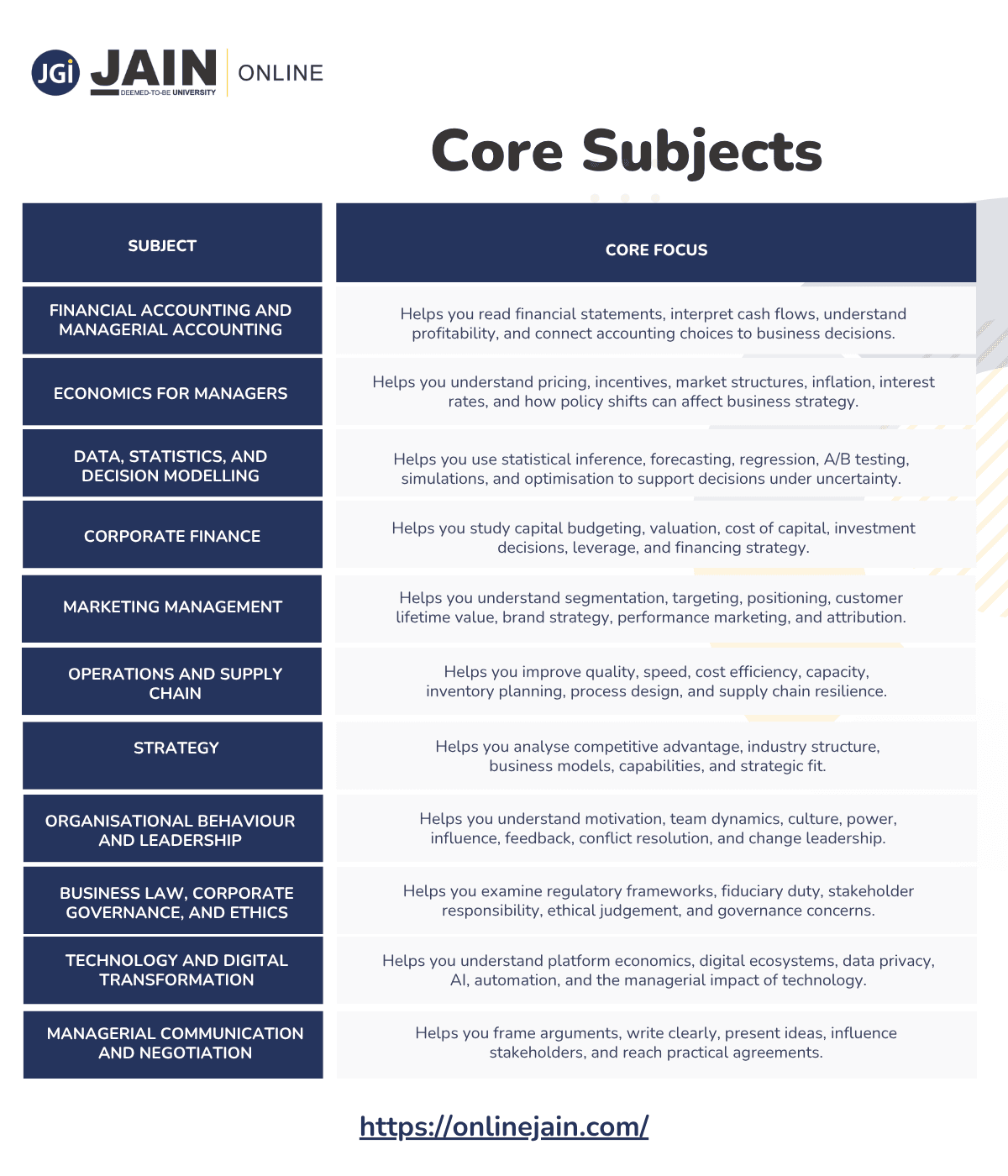
The core subjects in an MBA usually cover accounting, economics, data analysis, finance, marketing, operations, strategy, leadership, ethics, technology, and communication. These subjects help students understand how businesses operate across functions and make better managerial decisions.
What Are the Core Subjects in an MBA?
Pedagogically, many programmes blend lectures, problem sets, case method discussions, and experiential workshops. The case method is especially common because it requires students to make decisions with incomplete information, defend their reasoning, and respond to different viewpoints.
Assessment may include exams, business memos, presentations, financial models, strategy decks, group assignments, and live projects. These formats are designed to mirror cross-functional work in modern organisations.
The core curriculum matters because it helps students connect business functions. A marketing decision may affect finance. A supply chain issue may affect customer experience. A technology choice may create governance and ethical questions. The MBA core helps students see these connections before moving into deeper specialisation.
Electives and Concentrations in an MBA
Electives help students personalise the MBA without losing the broader management perspective.
Once the core subjects are completed, students usually choose electives based on their career goals, current skill gaps, and target roles. These electives may form a concentration or specialisation in areas such as finance, marketing, business analytics, entrepreneurship, product management, healthcare management, sustainability, operations, or international business.
The goal is to build a useful balance between breadth and depth. A good MBA pathway allows you to understand the organisation as a whole while developing stronger expertise in one or two areas.
For example:
- A marketer may take finance and analytics electives to strengthen their performance measurement skills.
- An engineer may take electives in product management, strategy, and marketing to prepare for business-facing roles.
- A founder may elect to take courses in entrepreneurship, finance, customer research, and operations to build a practical venture toolkit.
- A working manager may elect to take courses in leadership, strategy, and digital transformation to prepare for senior roles.
How to Choose MBA Electives Wisely
Use electives as a career-building tool, not just as a list of interesting subjects.
Before selecting electives, ask:
- What role do I want after the MBA?
- Which skills are repeatedly required in that role?
- Which subjects fill my current knowledge gaps?
- Which projects can help me build proof of capability?
- Which electives connect well with internships, live projects, or capstone work?
A strong elective plan should do three things:
- Build practical skills you can use soon.
- Signal a clear career direction to recruiters or employers.
- Create portfolio assets such as analysis decks, product specs, strategy memos, market research reports, or financial models.
If your goal is breadth, use electives to close functional gaps. If your goal is depth, sequence advanced courses with applied labs and a capstone or major project that supports your specialisation.
The Evolution of the MBA Degree
The MBA began in the early twentieth century in the United States as businesses needed more structured approaches to large-scale management, accounting, efficiency, and organisational design.
Over time, the degree expanded across regions, industries, and learning formats. Business schools in Europe, Asia, and other parts of the world adapted MBA programmes to local markets while keeping the central focus on analytical thinking, leadership, and managerial decision-making.
The MBA curriculum has also evolved to meet business needs. Strategy now includes platform competition, digital ecosystems, and network effects. Marketing includes digital channels, data, and customer analytics. Operations have moved beyond efficiency to include resilience, risk planning, and preparedness for global supply chain disruptions. Entrepreneurship has shifted from a niche interest to a major MBA pathway.
Responsible business has also become more important. Ethics, governance, sustainability, stakeholder management, and diversity-related topics now appear more often in the core or early electives.
Delivery models have changed too. Alongside the traditional full-time MBA, learners can now choose part-time, executive, online, hybrid, modular, and global formats. The structure has become more flexible, but the central purpose remains the same: to help learners integrate data, judgement, leadership, and values in complex business situations.
MBA Programme Capstone: Strategic Leadership
An MBA capstone is an integrative project where students apply learning from strategy, finance, marketing, operations, analytics, and leadership to a complex business problem.
The capstone is often the final proof of MBA learning. It may be delivered as a consulting assignment, a business simulation, a new venture project, a global immersion project, or a strategy challenge. The purpose is to show that students can move beyond theory and make practical, defensible recommendations.
It is an experience where you apply strategy, finance, marketing, operations, and leadership to a complex, ambiguous challenge. Think of it as your final proving ground for executive decision-making.
Common capstone formats:
- Strategy Consulting Lab: Work with an external organisation to diagnose a strategic issue, market entry, pricing, cost transformation, or growth acceleration. You conduct stakeholder interviews, design analyses, and present an implementation roadmap to executives.
- New Venture Project: Form a founding team, validate a problem-solution fit, model unit economics, and build a go-to-market plan. Many teams continue building beyond graduation.
- Boardroom Simulation: Assume C-suite roles and make interdependent decisions on capital allocation, product portfolio, and risk. Simulations compress years of strategic trade-offs into weeks.
- Global Immersion Capstone: Partner with firms abroad to navigate cross-border operations, localisation, and regulatory terrain. Cultural agility becomes part of the deliverable.
An effective MBA capstone project follows a disciplined arc:
- Scoping: Clarify the question and define success criteria. Mis-scoped problems waste analysis; good scoping aligns stakeholders from day one.
- Data Plan: Identify what you need, where it lives, and how you will access it ethically and securely.
- Analysis: Combine qualitative insights with quantitative models. Translate numbers into managerial implications.
- Options and Risks: Generate alternatives, evaluate trade-offs, and stress-test assumptions.
- Recommendation and Roadmap: Land on a clear action plan with milestones, owners, and metrics.
- Communication: Deliver findings in a crisp narrative with visuals, anticipating stakeholder concerns and constraints.
The goal is not to create a perfect forecast. The real value lies in the quality of reasoning, the ability to connect functions, the practicality of the recommendation, and the clarity of communication.
Dissertation and Major Project Completion
An MBA dissertation or major project helps students apply management concepts to a focused business question using research, evidence, analysis, and practical recommendations.
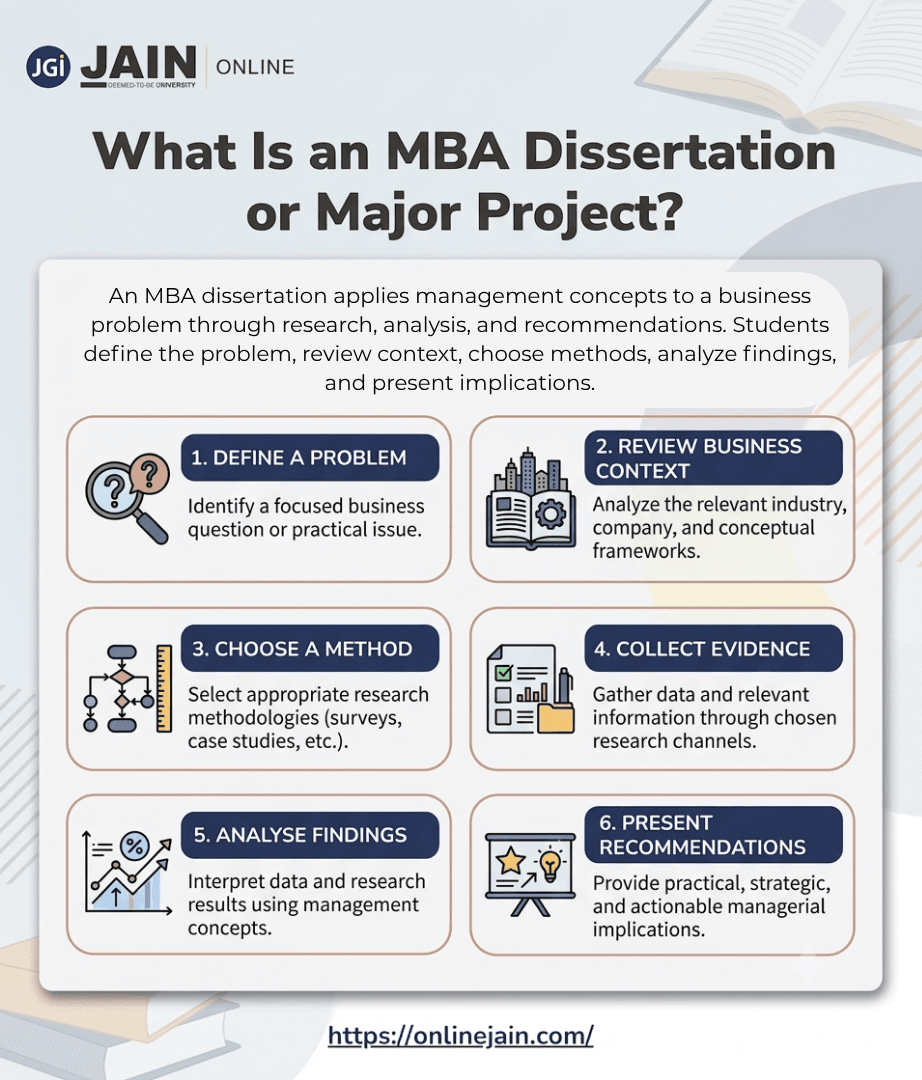
Depending on the institution, students may complete a thesis-like dissertation, an applied business project, a live industry project, or a final research report. While formats vary, most projects require students to define a clear problem, review relevant literature or business context, choose a method, collect evidence, analyse findings, and present managerial implications.
Typical components include:
Topic Selection: Choose a problem with managerial significance that can be examined within the time and data available. A focused question beats an overly ambitious scope.
Proposal and Literature Review: Frame the question in context, state what is already known, and identify the gaps. Connect theory to practice.
Methodology: Define your approach (qualitative interviews, survey design, case analysis, financial modelling, or mixed methods) and address validity and limitations.
Data Collection and Analysis: Gather evidence systematically, document sources and assumptions, and analyse with transparency.
Findings and Managerial Implications: Move from “what the data shows” to “what leaders should do.” Offer options, not just observations.
Reflection: Note what would change your conclusion, how to monitor leading indicators, and where future research or testing should focus.
Practical Tips for a Strong MBA Project
- Choose a focused question instead of a broad topic.
- Connect academic rigour with a real business problem.
- Use an industry mentor or stakeholder where possible.
- Create interim deliverables such as a problem-framing memo or early findings brief.
- Build an executive summary that can stand alone.
- Present recommendations with clear assumptions, risks, and next steps.
Whether it is called a dissertation, major project, applied project, or final report, the value lies in demonstrating that you can turn an unclear managerial question into structured, actionable guidance.
Types of MBA Programmes and Concentrations
MBA programmes are available in different formats to match different career stages, schedules, and learning preferences.
The right format depends on whether you want a full-time campus experience, continued work experience while studying, senior peer learning, geographic flexibility, or international exposure.
Primary formats:
- Full-Time MBA: Immersive, typically completed over one to two academic years. Suited for career changers or those seeking an intensive campus experience with placements and recruiting, student clubs, and internships.
- Part-Time/Evening or Weekend MBA: Designed for working professionals who want to keep momentum at work while studying. Progress is steady, and classroom discussions benefit from varied, real-time work contexts.
- Executive MBA (EMBA): Tailored for experienced managers, often with cohort-based schedules (e.g., weekends or modular blocks). Emphasis on peer learning, strategic topics, and immediate application on the job.
- Online/Hybrid MBA: Offers flexibility in geography and timing, with synchronous sessions, recorded lectures, and periodic in-person residencies depending on the programmes.
- Modular and Global Programmes: Compressed residencies, international modules, or multi-campus rotations for those who want global exposure without relocating long-term.
Concentrations can exist across all formats. In a full-time MBA, a concentration may include electives, internships, labs, and capstone work. In part-time or executive formats, it may align with the student’s current job responsibilities, enabling immediate experimentation and impact. In online and hybrid programmes, stackable certificates are often rolled into a concentration, allowing you to explore interests before committing.
When choosing a format, consider both the academic structure and your personal bandwidth. The best MBA format is the one you can complete seriously while still gaining the network, projects, guidance, and depth of learning you need.
MBA vs Specialised Master's in Business
An MBA and a specialised business master’s degree can both support career growth, but they serve different goals. An MBA is broader and more leadership-focused, while a specialised master’s degree usually builds technical depth in a specific business area, such as finance, analytics, marketing, or management.
Prospective students often weigh an MBA versus Master’s options such as a Master of Finance, Master of Business Analytics, or Master of Marketing. While overlaps exist, the programmes serve different purposes.
Key differences:
- Audience and Timing: An MBA typically serves candidates with professional experience seeking leadership roles or a significant career pivot. Specialised Master’s programmes often attract earlier-career candidates seeking technical depth in a single domain.
- Breadth vs Depth: The MBA prioritises breadth, strategy, finance, marketing, operations, and leadership, layered with electives. A specialised Master’s dives deep into one area (e.g., financial modelling or machine learning) with limited exposure to cross-functional management.
- Career Trajectory: MBAs frequently pursue general management, consulting, product management, or strategy roles where integration across functions is essential. Specialised Master’s graduates often start in analyst, associate, or technical specialist roles where depth is paramount.
- Pedagogy and Networking: MBA cohorts emphasise peer learning from diverse industries and leadership labs, with placement and recruiting infrastructure focused on managerial roles. Specialised programmes emphasise technical workshops, research methods, and domain-specific networking.
- Duration and Flexibility: Specialised Master’s programmes are often shorter and can be more cost-efficient if your goal is precision upskilling. MBAs take longer but can deliver broader career optionality and leadership acceleration.
MBA vs Specialised Master’s in Business
| Factor | MBA | Specialised Master’s in Business |
| Best For | Professionals seeking leadership roles, career pivots, or cross-functional management growth. | Learners seeking focused technical depth in one business area. |
| Typical Audience | Candidates with professional experience, though requirements vary by institution. | Often early-career learners or those seeking domain-specific upskilling. |
| Learning Focus | Broad business management across finance, strategy, marketing, operations, analytics, leadership, and ethics. | Deep focus on one area such as finance, business analytics, marketing, or economics. |
| Career Direction | Consulting, general management, strategy, product management, leadership tracks, entrepreneurship, or function shifts. | Analyst, associate, specialist, technical, or domain-focused roles. |
| Teaching Style | Case discussions, peer learning, leadership labs, simulations, live projects, and business problem-solving. | Technical workshops, research methods, applied assignments, and domain projects. |
| Flexibility | Often broader and useful for multiple paths. | More focused and efficient if the career goal is already clear. |
| Main Question to Ask | Do I want to lead across functions or make a major career shift? | Do I want deep skill-building in one specific business function? |
Which should you choose? If you aim to lead cross-functional teams, manage P&L, or pivot functions or industries, the MBA’s breadth and leadership emphasis are likely a better fit. If you love a specific function - quantitative finance, analytics engineering, or brand research - and want to go deep quickly, a specialised Master’s may be more efficient. Some candidates sequence both: begin with a specialised Master’s to enter a technical role, then pursue an MBA later to accelerate into management.
Popular MBA Specialisations and What They Lead To
MBA specialisations help students turn a general management degree into a focused career proposition.
A specialisation should not be chosen only because it sounds popular. It should connect with your target role, industry demand, prior experience, and the kind of work you want to do after graduation.
- Finance: Ideal for corporate finance, investment roles, or strategic FP&A. Expect advanced valuation, capital markets, risk management, and sometimes fintech electives. You will learn to build scenarios, challenge assumptions, and translate numbers into clear narratives for non-financial leaders.
- Marketing: Suited to brand management, growth marketing, and customer strategy. Courses emphasise behavioural insights, analytics, omnichannel campaigns, and pricing strategy. You will practise framing experiments, reading signals from noisy data, and aligning creativity with commercial outcomes.
- Operations and Supply Chain: For roles in manufacturing, logistics, or operations excellence. Electives include network design, S&OP, supplier strategy, and sustainability in operations. Graduates often drive cost, quality, and resilience agendas.
- Business Analytics: Targets data-driven decision roles. You will apply predictive models, experimentation, and data storytelling to managerial questions. The focus is on decision framing, governance, and adoption, not just algorithms.
- Entrepreneurship: Fits aspiring founders and innovation leaders. Expect start-up formation, venture capital, product-market fit, and growth mechanics. You will develop investor-ready materials and a roadmap of learning milestones.
- Technology and Product Management: A blend of strategy, UX research, and agile execution. You learn to prioritise roadmaps, define metrics, and coordinate with engineering and design under resource constraints.
- Healthcare Management: For leadership roles across providers, payers, and health-tech. Topics include clinical operations, reimbursement models, regulatory strategy, and patient-centric innovation.
- Sustainability/ESG: Prepares you to integrate environmental and social metrics into strategy. Emphasis on carbon accounting, sustainable finance, supply chain transparency, and stakeholder communication.
- International Business: Focused on cross-border strategy, localisation, currency, and regulatory considerations, and managing multicultural teams.
- Human Capital and Organisational Strategy: Suited to roles in people analytics, organisational design, and change management. You will study performance systems, incentives, and the link between culture and outcomes.
How to Get More Value From an MBA Specialisation
To get more value from your specialisation:
- Combine classroom learning with applied projects.
- Build portfolio assets such as strategy decks, financial models, product plans, research reports, or operating playbooks.
- Align electives, internships, capstone work, and extracurricular leadership with one career story.
- Speak to alumni, recruiters, and professionals in your target role before finalising your course choices.
- Choose a specialisation that reflects both interest and market demand.
A specialisation is useful only when it helps you solve real employer or business problems. It should both reflect your curiosity and meet market demand.
How to Choose the Right MBA Programme
The right MBA programme should match your career goals, learning needs, schedule, budget, and expected return on investment.
Before choosing a programme, look beyond the degree title. Compare the curriculum, format, faculty, industry exposure, alumni network, accreditation, career support, and placement or outcome data where available.
| What to Check | Why It Matters |
| Career Goal Fit | The programme should support your target outcome, such as promotion, career switch, entrepreneurship, leadership growth, or functional depth. |
| Curriculum Strength | The core subjects, electives, specialisations, projects, and capstone should match the skills needed in your target role. |
| Accreditation and Recognition | For an online MBA in India, check whether the degree is UGC-entitled, whether the university has strong NAAC accreditation, and whether the MBA programme has relevant AICTE approval. For example, JAIN Online offers UGC-entitled online degrees through JAIN (Deemed-to-be University), which is NAAC A++ accredited, with AICTE-approved MBA programmes. |
| Faculty and Industry Exposure | Strong faculty, visiting leaders, live projects, and industry interaction improve practical learning and help students connect theory with workplace decisions. |
| Format and Schedule | The programme should fit your work, family, location, and time commitments without reducing your ability to participate seriously. |
| Alumni and Recruiter Network | Alumni access, employer relationships, peer quality, and recruiter connections can strongly influence long-term value. |
| Cost and Financing | Compare tuition, scholarships, EMI options, loan burden, and opportunity cost against the career value the programme can create. |
| Career Support | Look at placement support, interview preparation, resume guidance, mentorship, career coaching, and access to hiring partners. |
| Outcome Transparency | Review available reports on roles, sectors, salary ranges, hiring partners, placement trends, and learner outcomes while remembering that results vary by student. |
Career Outcomes of an MBA
An MBA can support career mobility, leadership growth, and access to broader business roles. Still, outcomes depend on the school, market, geography, prior experience, specialisation, and the student's active use of the programme.
MBA graduates often use the degree for three broad outcomes:
- Function change: For example, engineering to product management or sales to strategy.
- Industry change: For example, from manufacturing to consulting or from the public sector to corporate roles.
- Leadership acceleration: Moving into roles with wider team, budget, market, or business responsibility.
Does an MBA Guarantee Career Growth?
No. An MBA does not guarantee a job, a salary increase, a promotion, or a career switch. It can improve your skills, network, confidence, and access to opportunities, but outcomes depend on several factors.
What affects MBA outcomes?
- Programme reputation and relevance
- Accreditation and employer recognition
- Prior work experience
- Quality of projects and internships
- Chosen specialisation
- Career services and recruiter access
- Alumni network
- Communication and interview readiness
- Economic cycle and job market conditions
- Location and industry demand
The strongest outcomes usually occur when students enter the MBA with a clear career thesis, use projects to demonstrate their capabilities, build relationships early, and align electives with real job requirements.
How to Evaluate MBA ROI
MBA ROI should be measured by comparing the total cost of the degree with the career, skill, network, and opportunity gains it can create over time.
A simple way to think about MBA ROI is:
| MBA ROI = Career Gain + Skill Growth + Network Value + Leadership Opportunity - Tuition Cost - Opportunity Cost - Loan Burden |
To evaluate ROI, consider both tangible and intangible returns. A practical ROI framework:
- Total Cost: Add tuition, fees, living expenses, and foregone earnings if studying full-time. Investigate scholarships, employer sponsorship, and loan terms to reduce net cost.
- Post-MBA Earnings Scenarios: Model conservative, base, and optimistic outcomes by role and geography. Factor in time to promotion and bonus variability.
- Career Optionality: Value the flexibility to pivot if markets change. This resilience can be as important as immediate salary uplift.
- Network and Brand Effects: Consider access to alumni, recruiters, and mentors. These compounding benefits often outlast early salary differentials.
- Personal Constraints and Preferences: Align timing, family priorities, and location with the programme format to avoid hidden costs or missed opportunities.
Do not calculate ROI solely based on immediate salary. A strong MBA may also support long-term career flexibility, better decision-making, stronger communication, access to leadership roles, and a wider professional network.
At the same time, be realistic. High fees, loan pressure, unclear career goals, weak programme fit, or poor market timing can reduce ROI.
How to Maximise MBA Outcomes During the Programme
To get more from an MBA, students should treat the programme as an active career-building platform rather than only an academic degree.
Use the first few months to clarify your target role, identify required skills, and map your course, project, networking, and internship choices backwards from that goal.
Practical steps include:
- Identify target roles and industries early.
- Speak to alumni and professionals before recruiting season.
- Choose electives that fill real skill gaps.
- Use internships, live projects, or part-time consulting to test your career direction.
- Build portfolio artefacts such as analysis decks, product briefs, operating plans, or market research reports.
- Practise structured writing, presentation, and interview communication.
- Join clubs or leadership roles that support your target career story.
- Ask for perspective before asking for referrals.
- Track your progress against skills, relationships, projects, and job-readiness milestones.
The MBA experience is most valuable when every major choice connects back to a clear purpose.
Is an MBA the Right Next Step for You?
An MBA is not a guaranteed outcome. It is a powerful platform that can help you build business knowledge, leadership readiness, decision-making ability, and career optionality when used well.
It may be the right choice if you want to move into leadership, change functions or industries, build a business, strengthen your management foundation, or gain access to a stronger professional network. It may not be the right choice if your goals are unclear, the cost is too high for your expected outcome, or a shorter specialised programme can meet your needs more efficiently.
Before deciding, compare the MBA curriculum, programme format, specialisations, capstone opportunities, career support, cost, and alumni outcomes. The right MBA is the one that helps you create value in the roles you want, not just the one that adds a qualification to your résumé.
Take the Next Step With JAIN Online
Understanding what an MBA is can help you make a clearer decision about your career goals, learning needs, and long-term growth. If you are looking for a flexible way to build business, leadership, and management skills, JAIN Online offers UGC-entitled online degrees backed by JAIN (Deemed to be University), which is NAAC-accredited with an A++ grade. Its learning model includes 30+ specialisations, AI fluency through 30+ tools, micro-credentials in every semester, access to 100+ advanced courses, and 20,000+ LinkedIn Learning courses. With a learner network spanning 8,000+ corporates, 21 industries, and 45+ countries, along with reported outcomes such as 2,000+ hiring corporates, 15,454+ jobs facilitated, a 65% average salary hike, a 78% career success rate, and an 84% course completion success rate, JAIN Online can help you take a more confident step towards building your management career.
Frequently Asked Questions (FAQs)
1. What is an MBA and what does it actually develop?
An MBA is a postgraduate business degree that develops management, leadership, communication, analytical, and decision-making skills. It helps learners understand finance, marketing, operations, strategy, people management, technology, and ethics, enabling them to solve business problems and lead across functions.
2. How is the MBA curriculum structured?
Most MBA programmes begin with core subjects such as accounting, finance, marketing, operations, economics, analytics, leadership, and ethics. Students then choose electives or specialisations and often complete projects, simulations, internships, or a capstone to apply learning to real business situations.
3. What MBA Programme formats are available, and how do they differ?
Common MBA formats include full-time, part-time, executive, online, hybrid, modular, and global programmes. They usually share a similar academic structure but differ in their schedules, pace, delivery methods, peer groups, work flexibility, and levels of career support.
4. What are the typical core courses in an MBA and why are they important?
Typical MBA core subjects include financial accounting, managerial accounting, economics, corporate finance, marketing management, operations, strategy, organisational behaviour, business ethics, data analysis, technology, communication, and negotiation. These subjects create a shared foundation for managerial decision-making.
5. How do MBA electives and specialisations help without losing the big-picture view?
Electives and specialisations allow students to deepen their expertise in areas such as finance, marketing, analytics, entrepreneurship, product management, healthcare, sustainability, and operations. They help students align the MBA with target roles while retaining a broader business management perspective.
6. What is the difference between an MBA and a specialised master’s degree?
An MBA is broader and usually prepares students for leadership, management, consulting, entrepreneurship, or career shifts. A specialised master’s degree focuses deeply on one area, such as finance, analytics, or marketing and may be better for learners seeking focused technical upskilling.
7. Is an online MBA worth it?
Yes, an UGC-entitled online MBA from a recognised university carries the same degree validity as a regular MBA in India. The formats differ in delivery, immersion and placement structure, so compare accreditation, faculty access, peer interaction and career support before enrolling.
8. Does an MBA guarantee a higher salary?
No. An MBA does not guarantee a higher salary. It can improve access to certain roles and leadership paths. Still, salary outcomes depend on the school, location, industry, prior experience, specialisation, job market, and individual performance during and after the programme.
9. How do I choose the right MBA specialisation?
Choose an MBA specialisation by matching your target role with required skills, industry demand, prior experience, and project opportunities. A good specialisation should help you build practical expertise, create portfolio proof, and make your career story clearer to employers.
10. Is an online MBA equal to a regular MBA?
An online MBA can be valuable if the institution is recognised, the curriculum is strong, faculty access is good, and the programme offers meaningful peer interaction, projects, and career support. Before enrolling, check accreditation, delivery quality, employer recognition, and outcome transparency.
11. How can I assess whether an MBA is worth it for my goals and ROI?
Use an evidence-based approach by mapping your career goals to programme strengths, alumni outcomes, and recruiting pipelines. Weigh tuition and opportunity cost against expected compensation, network value, and skill gains at the right time for your career.
Related Blogs
 Programs
Top Interview Questions for Social Media Roles
The role of a Social Media Manager is essential in today’s digital-first world. Whether you're a beginner, intermediate-level professional, or a senior candidate, excelling in a social media manager interview requires preparation, creativity, and strategic thinking.
Read More → Programs
Top Interview Questions for Brand Manager Roles
Brand management is a dynamic and strategic role that involves building, maintaining, and growing a brand's image and market presence. Companies seek brand managers who can blend creativity with data-driven decision-making.
Read More → Programs
Why Marketing Leadership Needs Digital-Savvy Professionals
In today’s fast-paced and ever-evolving business landscape, marketing leadership demands more than just traditional expertise. As technology continues to reshape industries, the need for digital-savvy marketing professionals has become a critical success factor for organizations worldwide.
Read More →